
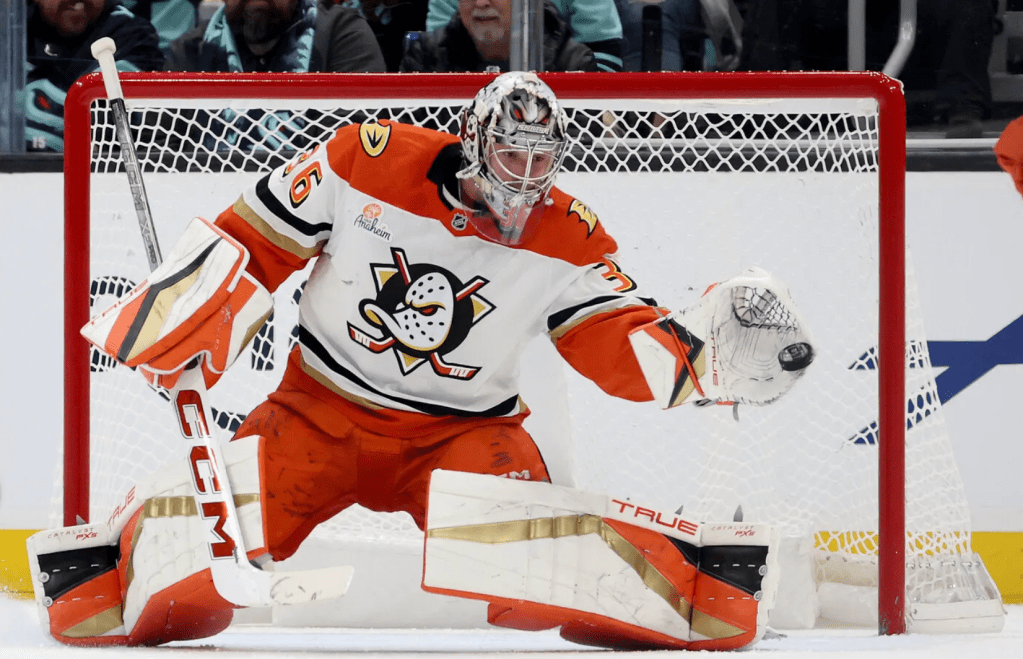
Another year, another season of John Gibson trade speculation. With the trade deadline just a few weeks away on March 7, Gibson may not be a Duck for much longer. The 31-year-old goaltender has been discussed in rumors for a long time, but it seems like there are more factors than ever that could push Gibson out the door:
Improvement in Play
For the first time since the 2018-2019 season, Gibson is putting up legitimately impressive numbers. In 23 games this season, he has a 2.70 goals against average (GAA) and a .915 save percentage (SV%), which is good enough for 7th in the NHL among qualified goalies. And those numbers don’t even factor in the quality of chances that Gibson faces on a nightly basis, as the Ducks are considered one of the worst, if not the worst, defensive teams in the league.
Goals Saved Above Expected (GSAx) is a statistic that attempts to include the quality of shot attempts in its calculations to give more credit to goalies who play in a tougher environment. There are a few different sites that have their own formulas, but they all agree that Gibson is one of the better goalies in the league in this statistic. Using MoneyPuck’s version, Gibson sits in 7th in GSAx at 14.6. However, he has played notably fewer games than 5 of the 6 goalies in front of him, meaning he hasn’t had as much time to accumulate GSAx. To account for this, we can use MoneyPuck’s GSAx per 60 minutes statistic to see which goalies perform the best when factoring out the pure volume of minutes played. Among goalies with at least 10 games played, Gibson ranks 3rd in the NHL at 0.69 GSAx per 60.
Gibson was an elite goalie in his early seasons, but in recent years, his play has fallen alongside the play of the team around him. It’s hard to put all of the blame on Gibson when the Ducks have been a terrible defensive team for years now. He has had stretches of impressive play over that time, but Gibson could not sustain that success for long periods of time. This season, however, Gibson has been an elite goalie no matter how you want to look at it. Any competitive team looking to upgrade its goaltending should be considering adding Gibson.
Capable Successor
This season, Lukas Dostal has emerged as a reliable, quality NHL goaltender. The 24-year-old netminder has worked his way up through the professional ranks, and he is excelling with the Ducks this season. As impressive as Gibson’s stats are, Dostal’s are right there with him. In 32 games, Dostal has a 2.86 GAA and a .911 SV%. He also has a GSAx per 60 of 0.65, which is 4th (right behind Gibson) in the league among goalies with at least 10 games played.
Dostal had been a highly touted goalie prospect for a few years, but he has officially cemented himself as the future of the Ducks in net. Considering the Ducks likely won’t be competitive for at least another couple of years, it would be wiser to invest in someone Dostal’s age as opposed to Gibson’s. On the flip side, a team looking to win in the immediate term could really use Gibson to improve its odds at winning the Stanley Cup. Before Dostal’s emergence, the Ducks were likely more reluctant to move Gibson, as that would have left an enormous hole on an already awful team. Now that Gibson’s heir is ready to take the reins, the Ducks should be more prepared for life without Gibson.
Rising Salary Cap
One of the biggest roadblocks to trading Gibson has been his contract. In 2018, Gibson signed an 8-year, $51.2M contract, which comes with a cap hit of $6.4M. That was a massive contract for a goaltender back then, and it is still pretty expensive right now. This season, Gibson has the 7th highest cap hit among goalies (it will fall to 11th highest next season). With Gibson’s play in recent seasons, that was a large obstacle in a potential trade. It was a huge risk to take up that much of a team’s cap space for a goalie that hasn’t been playing up to that lofty number. Teams would understandably be reluctant to part with anything of value to take that on.
The COVID-19 pandemic altered the financial landscape of the NHL and caused the salary cap to stagnate. From the 2018-19 season to the 2023-24 season, the cap moved from $79.5M to $83.5M, a jump of just 5% over 6 years. Teams have been squeezed on cap space during that time, but it seems like the league is finally coming out of that period of stagnation. This season, the cap jumped up to $88M, and it is projected to go to $95.5M next season, then $104M and $113.5M the following seasons. That growth has not been seen in the salary cap era (since 2005-06), and it will be fascinating to see what teams do with that space. Salaries will go up, and Gibson’s cap hit won’t be as prohibitive as it has been.
Contract Term
The other part of Gibson’s contract that has scared teams away is the number of years left. Before this season, the combination of Gibson’s iffy play with the long term left on his deal made him a very risky asset to acquire. Teams would be hoping that Gibson’s play would improve on a better team, but if they ended up being wrong, that contract would quickly become an anchor. Gibson only has 2 years left on his deal after this season, and as time goes on, the time risk continues to decrease. There will still be teams that are skeptical of Gibson, but his risk profile has not looked this good in a long time.
The Case to Keep Gibson
Even though the Ducks are near the bottom of the standings, they have one of the best goaltending tandems in the NHL. Gibson and Dostal give them a chance to win every game, even though the team is regularly outplayed. It is safe to say the Ducks would be lower in the standings if one of Gibson or Dostal were not on the team. After years of futility and stagnation, it would be nice to see the Ducks take a step forward in the standings to show some kind of progress.
The league has also started trending toward strong goalie tandems over a single dominant starter in recent years. Many teams have 2 quality goaltenders who each play at least 30 games, so each goalie gets adequate rest. It’s very possible that Gibson and Dostal have played so well in part because they don’t have to play every night. A solid tandem also promotes internal competition, which pushes each goaltender to play his best so he doesn’t get overtaken by his teammate.
While Gibson has a relatively large contract, the Ducks are in a position where they can afford to keep him without sacrificing other parts of the roster. Anaheim is much closer to the salary cap floor than they are to the ceiling. If the Ducks were short on cap space or needed some more room to fit in another contract, then it would make sense to try and move Gibson’s money, but that’s not the case.
After the trade of Cam Fowler in December, Gibson became the last of the old guard in Anaheim. Maybe it makes sense to fully move on from that era, but Gibson does represent the last connection to the last time the Ducks were a competitive team. He has big-game experience that can be valuable to the rest of the roster, especially Dostal. Gibson is also a seemingly well-liked guy and a respected teammate, and it would be yet another hit to the Ducks’ locker room if he is dealt away.
The Case to Trade Gibson
It is true that Gibson helps the current Ducks team win more games, but how much does that really matter in the grand scheme of things? Not only would trading Gibson net the team some assets, but it would also halt the forward momentum in the standings, which would land the Ducks a better draft pick. Gibson’s play has helped the team be more competitive this season, but when your goalies are bailing you out on a regular basis, it feels more like a crutch than actual progress. The team around the goalies has to play better, and one avenue for improving could be through a return for Gibson in a trade.
Dostal’s emergence has made Gibson a luxury item. It’s nice to have a second capable goalie, but only 1 goalie plays at a time, so I wouldn’t call it a necessity. The Ducks can trade from that position of strength and use it to address a different need elsewhere on the roster. A Gibson trade would also cement Dostal as the #1 goaltender on the roster, something that he’s going to have to get used to at some point anyway.
While Gibson’s contract isn’t prohibitive to the Ducks adding quality players at the moment, it could become a problem if the team decides to spend money this offseason. As we have learned over the salary cap era, every dollar matters, and Anaheim could find more value spending Gibson’s money on other parts of the lineup.
We should also consider what Gibson wants. Over the last few years, there have been frequent rumors ranging from Gibson being open to a change of scenery to Gibson requesting a trade. It’s hard to say what the truth is here, but it’s not hard to imagine a goalie with Gibson’s pedigree wanting to play for a more competitive team. At 31 years-old, Gibson isn’t at the end of his career, but he’s likely on the back half. How many more elite years does he have left? Does he want to spend more of them on a team with no chance to win a Stanley Cup? If he does want out, should that factor in to GM Pat Verbeek’s decision? If it were me, it would impact what I choose to do with Gibson. I can’t blame Gibson for wanting to go elsewhere after being stuck on a bad team for so long, and I also want players on the team who actually want to be there. This doesn’t mean that I would simply give Gibson away to do him a favor, but I would be more open to moving him if that were the case.
What Would the Return Look Like?
It is hard to pinpoint exactly what the Ducks would ask for in a return for Gibson. The first important question is how much money are the Ducks willing to retain, if any? Gibson at a $6.4M cap hit probably has some value, but if the Ducks were to retain the maximum 50% of his remaining contract, that would bring Gibson’s number down to $3.2M, and it would go 2 years beyond this season. That would represent enormous value to a contending team looking to win a Stanley Cup in that window. My personal philosophy is that if you plan to retain any salary in a trade, you should at least see what extra value you can get by retaining the maximum 50%. Obviously that’s easy for me to say since it’s not my money, but considering teams are only allowed to retain on 3 contracts at any given time, they should try to maximize each of those 3 slots.
The Ducks could be interested in a number of different kinds of assets in a Gibson trade. Anaheim is likely looking to improve the NHL roster right now, so younger players with years of contract control would be at the top of the list. Picks and prospects wouldn’t be ideal, but stockpiling those assets could allow the Ducks to make another trade for a quality player. If Gibson were traded during this season, I would also expect to see a lesser goalie as part of the return to pair with Dostal for the remainder of the year. In addition to retaining money, the Ducks could also simply take back another player with little to no value to balance out the salary. There are a lot of avenues the Ducks could go on a Gibson trade, but the bottom line is that it doesn’t make sense to make a deal without acquiring assets that help the team well beyond this season.
Potential Trade Destinations
It is not easy to find fits for Gibson. Most of the competitive teams already have a competent goalie they can rely on, and the bad teams in the league don’t have much reason to spend assets on a 31-year-old goalie. An in-season starting goalie trade is difficult and risky. Unless a team feels desperate to improve their goaltending, I think an offseason Gibson trade is more likely. It is also important to note that Gibson has a 10 team no trade list, meaning he can block a trade to any 10 teams of his choosing. If he does want to move on, I don’t see that being a problem unless the Ducks try to send him to a bad team.
Both Carolina and Edmonton have been linked to Gibson in recent months, but I also came up with a few more options that could make sense at some point in the near future:
Carolina Hurricanes
Carolina has been a well-oiled machine for a number of years now, but they have not been able to get over the hump and make it to the Stanley Cup Finals. They are a model of consistency, but they seem to come up short when it matters. People say they need more gamebreaking talent, and they have tried to address that through acquisitions of Jake Guentzel (who signed with Tampa Bay after last season) and now Mikko Rantanen.
One area they have not really addressed is their goaltending. Carolina’s management has been hesitant on committing much money or term to their goalies. While their goalies have still performed well, they haven’t been particularly consistent or reliable. Currently, Carolina employs the older but often injured Frederik Andersen and the young but erratic Pyotr Kochetkov. Both goalies have the ability to win games, but neither of them instills long-term confidence. Gibson would represent an upgrade over both of them and would provide cost certainty at the position over the duration of his contract. The Hurricanes only have about $2M in cap space, so there would have to be some more money moved around to make it work. I think there is a fit for Gibson with Carolina, but I have a hard time seeing the Hurricanes giving up what the Ducks want.
Detroit Red Wings
After making the playoffs for 25 consecutive years, the Red Wings haven’t been back since 2016. The fan base has grown impatient with the lack of progress, but they have shown signs of life the last couple of seasons. Last season, Detroit was tied in points for the final playoff spot, but lost the tiebreaker. This season started off poorly, but they hired a new coach and have been red hot ever since. They currently sit in the last playoff spot, but there are 4 teams within 4 points of them with a third of the season left to go.
I actually thought a Gibson-to-Detroit deal made a lot of sense last offseason. However, Detroit signed Cam Talbot and Jack Campbell to add to Alex Lyon and Ville Husso. None of these 4 goalies are studs, but it was an attempt by Detroit to throw darts and hope they hit a bullseye with 1 of them. Husso and Campbell have been banished to the AHL, but Talbot and Lyon have performed adequately. I still wouldn’t be particularly confident in either of them, but the Red Wings might not see them as an issue at this point. Detroit also has young Sebastian Cossa waiting to take the reins eventually, but he is not ready to lead a team to the playoffs. I think Gibson would be an excellent bridge to Cossa, but the signing of Talbot does make things slightly more complicated. Husso, Lyon, and Cambpell are all free agents after this season, but Talbot has 1 more year left. I could maybe see Detroit having interest in Gibson in the offseason to pair with Talbot for 1 year before bringing Cossa up full time. I think it would be difficult to fit Gibson into that team right now, even thought the Red Wings do have over $12M in deadline cap space, but if their goaltending falters this year, I believe they would be a suitor for Gibson in the offseason.
Edmonton Oilers
Edmonton is in win-now mode. They were 1 game away from winning the Stanley Cup last season and they look poised to make another long run in the playoffs. With Evander Kane seemingly on Long Term Injured Reserve (LTIR) for the remainder of the regular season, the Oilers will have about $5M in cap space to improve their roster before the trade deadline on March 7.
It is unclear how high a goaltender is on Edmonton’s priority list. Stuart Skinner is Edmonton’s #1 goalie right now, with Calvin Pickard as his backup. Skinner is a solid goalie, but he hasn’t been particularly consistent in his young career. You would think that a goalie who got his team to game 7 of the Stanley Cup Finals would have the confidence of his team, but it hasn’t seemed like it. Edmonton has such a solid team around him that his job shouldn’t be that difficult, but sometimes they seem to lose faith in him. Pickard is a passable backup goalie, but they don’t have the confidence in him to take over if things go downhill for Skinner. Edmonton’s interest in Gibson ultimately comes down to their confidence in Skinner. If they feel like they need to upgrade him, then Gibson immediately becomes a real possibility for the Oilers.
Vegas Golden Knights
Vegas seems to be permanently in win-now mode, even though they won the Stanley Cup recently in 2023. Ever since their fantastic inaugural season in 2017-18, they have been adding piece after piece to improve their roster. They have also shown no fear in discarding their once important players in an effort to play for the Stanley Cup every year.
The Golden Knights currently have a decent tandem in net. Adin Hill backstopped the team to its championship in 2023, and he has had an OK season. His backup, Ilya Samsonov, has battled inconsistency throughout his career, but he has been passable for Vegas. The interesting part about this duo is they are both unrestricted free agents after this season, meaning Vegas does not have any goalies signed for next year. Gibson would be an upgrade in net, and he would solidify that position for the remainder of his contract. I assume that Vegas is comfortable with its goaltending for the time being, but I think Gibson could be an offseason target for the Golden Knights. They also only have about $3.4M in deadline cap space, so it might be difficult to fit Gibson in this season anyway.
Honorable Mentions: Columbus Blue Jackets, Philadelphia Flyers, Utah Hockey Club
What Would I Do?
With the information we currently have, I would not be in a hurry to trade Gibson. There are 2 conditions that could get me to change my mind:
- Gibson’s preference is to move on and join a more competitive team.
- A team makes an offer that includes a high-potential young player/prospect that fits what the team needs.
Regarding the first point, I mentioned earlier that there has been speculation on Gibson’s desire to go elsewhere. That isn’t public information, but if it were true, I would be looking to trade Gibson. He has endured some very difficult times in Anaheim, and being the goalie for those teams must have been excruciating. If he doesn’t want to spend his time with a bad team anymore, then I would try to make that happen. With that being said, I would still not simply give him away. His improved play has undoubtedly made him easier to trade and he could even get a pretty nice return.
On the second point, a Gibson trade would be worthwhile if the return had a legitimate chance to make the Ducks better off in the long run, even if it made the current team worse. The Ducks could use a goal scoring forward (I identified some right-shot options here) or a young right-shot defenseman. If the offers are something like a 2nd round pick, a half decent prospect, and a bottom-of-the-lineup roster player, then I’m not sure that would get me to trade Gibson.
If I had to put money on it, I would bet that Gibson is a Duck for the rest of the season, but also that he isn’t a Duck at the start of next season (assuming he stays healthy and continues to play well). I just think that the Ducks have no reason to rush a trade, and there aren’t enough desperate suitors to drive the price up at this moment. In the offseason, teams will have more cap space to work with, and it should be easier to integrate a goalie into a system through training camp rather than in the middle of the regular season.


 All Mighty Hockey Talk
Leave a comment