
At the start of the season, I identified 5 key areas where the Ducks needed improvement. Now that the season is halfway through, there is a big enough sample size to see if there has been any tangible changes in those areas.
Shot Generation
One interesting trend this NHL season is that teams are putting up fewer shots on goal. In the 2023-2024 season, teams averaged 30.3 shots on goal per game. So far this season, that number has gone down to 28.5, which is a pretty significant reduction in just 1 year. There are a couple potential reasons for this phenomenon. First, there has been a recent trend in teams preferring defensemen with long reaches and good skating ability. These traits are prioritized because they take space away from opposing players, forcing them to get rid of pucks quicker and reducing their windows to get clean shots away. Another reason could be attributed to the prevalence of analytics. The concept of expected goals factors in both the quantity and quality of shots taken (read more about expected goals here). It seems that teams are focusing more on the quality of shots rather than the quantity, as there appears to be a lower volume of low-quality shots being taken.
In terms of shot volume, the Ducks appear to have improved. Last season, Anaheim averaged 26.8 shots on goal per game, which was 29th in the league. This year, the Ducks are at 28.2 shots on goal per game, currently ranking them 20th in the league. Part of this increase comes from Anaheim’s play at 5v5, and another part of it comes from the fact that the Ducks have had more power play time per game this season (5:15) versus last season (4:43). That extra 32 seconds per game naturally leads to more shots on goal. The Ducks are still in the bottom third of the league in shots for per 60 at 5v5, so there is still room to improve.
Head coach Greg Cronin is still trying to figure out line combinations that work (other than Vatrano-Strome-Terry). Finding the right duos or trios can go a long way in connecting plays and generating shots. Before Zegras got hurt, he and Carlsson had some promise, so maybe that can turn into something if they stick together longer. Gauthier and McTavish have also shown flashes while they’ve been on the same line. I still think they are missing a top 6 winger (preferably a right-shot one), but there should be enough pieces to find some good combinations.
Faceoffs
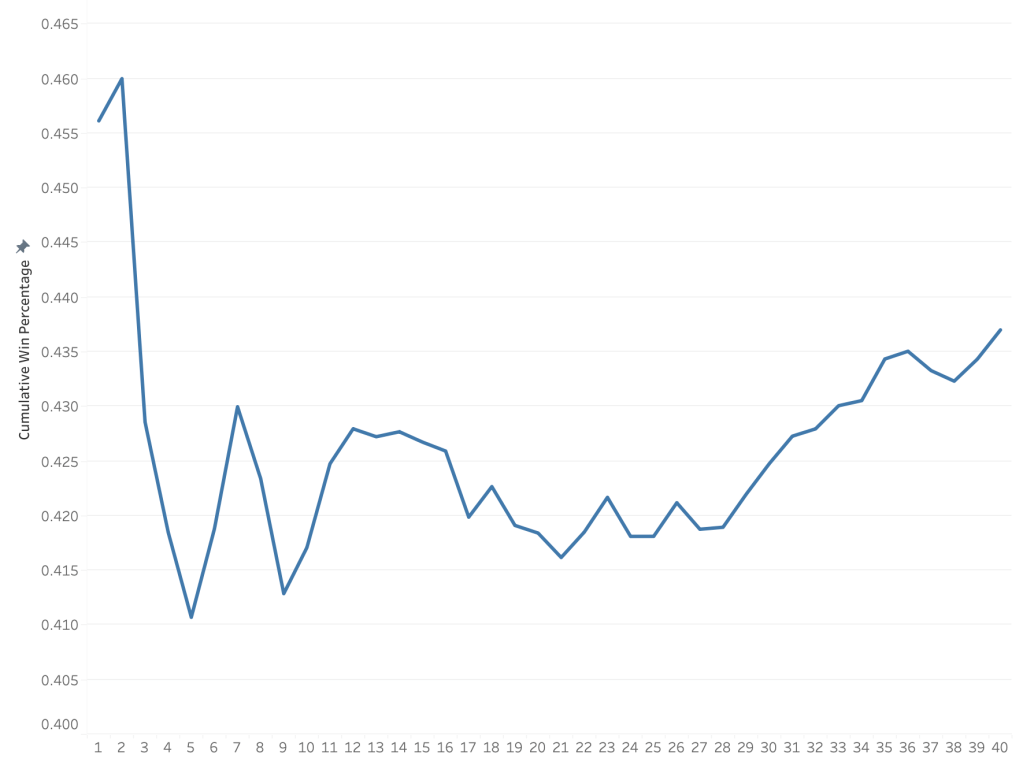
Unsurprisingly, the Ducks are the worst faceoff team in the league this season. I called last year’s faceoff win percentage of 46.7% “pathetic.” If that’s pathetic, then feel free to come up with an even harsher word for this year’s win percentage of 43.7% through 40 games. I said it’s unsurprising because the Ducks lost 2 of their best faceoff men from last season (Adam Henrique and Sam Carrick) and did not replace them with anybody. Of the 4 regular faceoff men on the team, 3 of them are 25 years old or younger (Lundestrom is 25, McTavish is 21, and Carlsson just turned 20). Typically, you get better at faceoffs with age and experience, so this is somewhat to be expected.
In almost every situation, the Ducks are well below average in faceoff percentage. The fact that they only have 1 right-shot player who takes regular faceoffs (Strome) makes them very susceptible to draws on the right side of the ice, where they have only won 38.3% of draws (and Strome isn’t even good at winning draws on his strong side anyway). They win 43.75% of draws on the power play, they win 43.4% of draws on the penalty kill, they win 45.1% of draws in the defensive zone. No matter what stat you look at, the Ducks are bad at it. If the Ducks were closer to 50% as a team, I believe they would have prevented a couple more goals and scored a couple more, too.
Now, here is some good news. The graph below shows the Ducks’ cumulative running faceoff percentage through the first 40 games of the season. In the last 10 or so games, thery have been trending upward. Carlsson in particular has raised his faceoff percentage from the low 30s to 39.7%. It’s still not a great number, but it’s a significant improvement. I am hoping this trend continues and the young centers keep getting better.
Minor Penalties
Last year’s Anaheim team had an extremely difficult time staying out of the penalty box. They had the most penalty kill opportunities per game (4.02) and penalty kill time on ice per game (6:17). They have improved significantly in this area so far this season. They are now middle of the pack in penalty kill opportunities per game (2.85) and penalty kill ice time per game (4:32). I believe this is one of the major reasons why the team has been much more competitive this season in comparison to last.
While there are still some individual players who take too many penalties, there is clearly an improvement this season. Last year, Vatrano, Gudas, and McTavish made up 3 of the top 4 players in the NHL in minor penalties taken. Gudas is now tied for 18th in the NHL with 13, Vatrano is right behind him at 12, and then Johnston (11), Killorn (10), McTavish (10), and Strome (8) are the next biggest offenders. There have definitely been steps taken to reduce penalties taken, and the entire organization (from players to coaches to the front office) deserves some credit for the significant improvement.
Penalty Kill
While the penalty kill hasn’t been as busy as it was, it still hasn’t led to material improvement. Last season, the Ducks were 31st in the league in PK% at 72.4%. This year, they are up to 26th in the league at 73.7%, which is still pretty poor. Thankfully, the reduction in penalty kill opportunities has minimized the negative impact of the poor penalty kill. Last season, the Ducks gave up a ridiculous 1.11 goals per game on the penalty kill. This year, it is down to 0.75. That is still 5th worst in the league, but you can see how that small improvement has given them the ability to compete in more games. The Ducks might need to start experimenting with new personnel on the penalty kill, especially among the forwards. If the Ducks want to be a playoff team, the penalty kill has to improve.
Last season, the Ducks were tied for 2nd in shorthanded goals. Part of that can be attributed to the sheer amount of shorthanded ice time they had, and another part can possibly be attributed to a riskier penalty kill strategy. This season, the Ducks have not scored a single shorthanded goal, yet their penalty kill percentage is only marginally better. Obviously, the goal of a penalty kill isn’t to score, but having players that are at least threats to score can cause power play units to play differently. I would try giving Terry, Gauthier, and Carlsson some more minutes on the penalty kill and see how that goes.
Power Play
Anaheim’s power play continues to act as a momentum drain for the team. Last season, they had the 8th worst power play at 17.9%. So far this season, it is operating at 13.6%, making them the 3rd worst in the NHL. New assistant coach Rich Clune is still figuring out how to deploy Anaheim’s skilled players with the man advantage. There has been a lot of mixing and matching in an effort to figure out combinations that establish zone time and generate chances, but there has not been any sustained success. Zegras has probably been Anaheim’s most effective player on the power play, but he’s been out for a month, which has sent the power play into a tailspin.
There is plenty wrong with how the power play units operate. They have trouble entering the zone with possession, making it harder to get the unit set up and generate scoring chances. Also, once in the offensive zone, the players on the ice are relatively stationary, making it easier for the penalty killers to anticipate passes and kill plays. The best power play units either move around more fluidly or use other types of deception to keep penalty killers on their heels. You just don’t see a lot of confidence with some of the players in the way they handle the puck or look to attack the net. The best units move the puck around decisively and with purpose, but it doesn’t seem like the players have faith in what they’re doing.
The Ducks also lack real shooting threats. Vatrano is really the only one who might strike fear in his opponents. Leading goal scorer Troy Terry has his moments on the power play, but most of his damage seems to come off the rush, which isn’t how power plays are designed to play. Gauthier and McTavish both have strong shots, but they haven’t figured out how to utilize them yet. From the point, Zellweger and LaCombe have shown some ability to be dangerous with their shots, but they haven’t established themselves as legitimate threats yet. If opponents respect a player’s shot, they will be forced to give up space elsewhere to take that shot away, which should open up another player.
Power play units lose confidence and momentum when penalty killers are able to clear the zone. The easiest way for a penalty kill to get the puck out is to win faceoffs to gain possession before the power play can even touch the puck. It should come as no surprise that the Ducks are dead last in the league in power play faceoff percentage at 43.6%. I have also been tracking how the Ducks perform on the very first faceoff of the power play. This particular faceoff is important because the power play team gets to decide which side of the ice the faceoff takes place on, meaning they should have a notable advantage in winning that draw and getting the power play off on a good foot. The Ducks have won 47.9% of these faceoffs, which is very poor considering the advantages I just described. Adding a faceoff ace who can play on the power play could give a boost to the team’s efficiency.

 All Mighty Hockey Talk
Leave a reply to Anonymous Cancel reply