
Late July through the end of August is always the least eventful time of the NHL calendar. Now that the majority of free agents have signed, we are pretty much just waiting for rookie camps to start in September. You will some random trades and signings sprinkled over the next six weeks, but teams have completed most of their of offseason work by now.
Ducks’ General Manager Pat Verbeek said he wanted two players this offseason: a right-shot top six forward and a right-shot top four defenseman. He unfortunately hasn’t accomplished either of these goals yet, but he still has time to make something happen before the season starts.
I wanted to look closer at one of his goals: the right-shot defenseman. More specifically, the “right-shot” part of it. I am going to spend the rest of this post dissecting why right-shot defensemen are so valuable and how important it is for the Ducks to add one in the near future.
Right-Handed vs. Left-Handed
Before I get into the hockey analysis, I’m going to take a step back and talk about what it actually means to be “right-handed” or “left-handed” in hockey. Here is a helpful graphic from Bauer (source) that illustrates the differences:
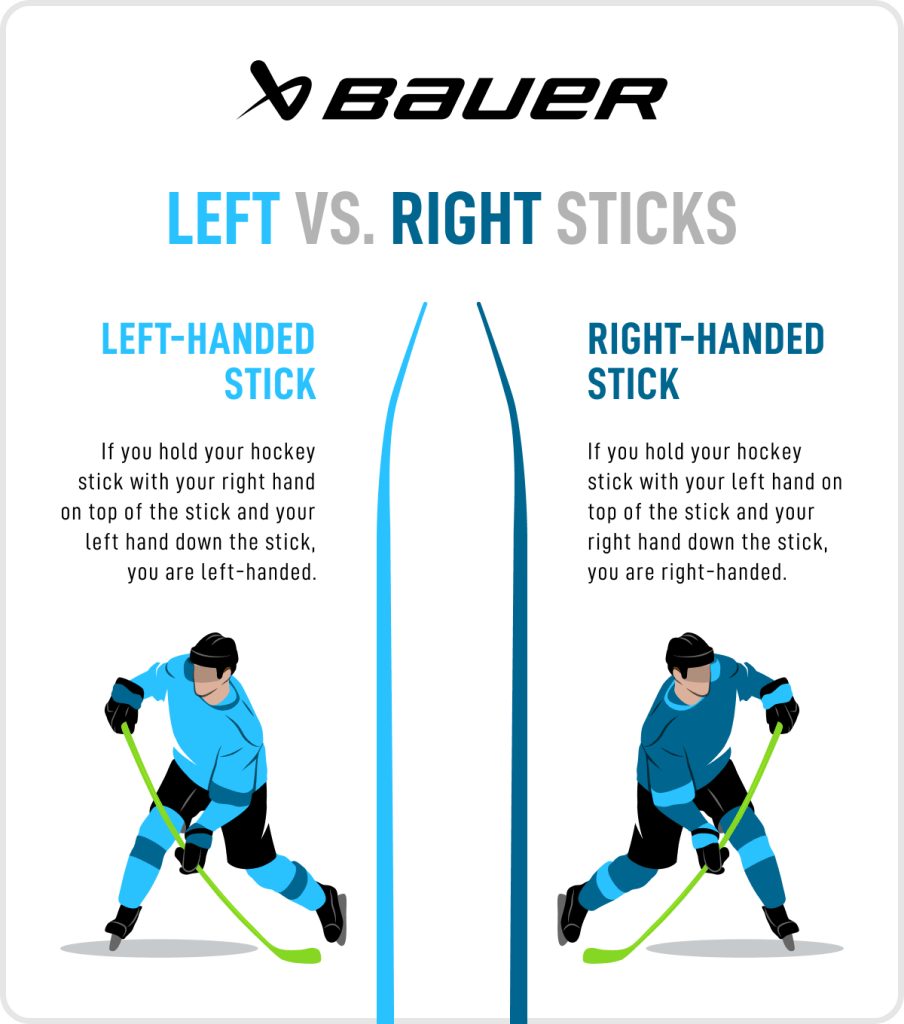
As you can see, the main differences are the curve of the blade (the bottom part) of the stick and the orientation of your hands on the stick.
The names “left-handed” and “right-handed” are actually a bit misleading in hockey. It might come as a surprise to some people that the majority of hockey players use “left-handed” sticks, going against the fact that most people in the world are right-handed. Most “left-handed” hockey players aren’t actually left-hand dominant. The placement of your dominant hand impacts your strengths with your stick. If you are right-hand dominant, but use a left-handed stick, that means your right hand is on top at the butt end of the stick. Generally speaking, this allows for better puck control and stick-handling ability. If you are right-hand dominant and use a right-handed stick, then your right hand is the bottom hand on the shaft of the stick. This placement allows for more power behind passes and shots.
As you can see, there is a trade-off between using a right-handed stick and a left-handed stick. A right-handed stick always felt more comfortable for me because the orientation was similar to how I held a baseball bat. Many people, however, learn with their dominant hand on top, leading them to use a left-handed stick, even though they are right-handed.
Right-handed and left-handed sticks get their names based on the stick’s orientation relative to your body. At rest, the blade of a right-handed stick will be on the right side of your body, and the blade of a left-handed stick will be on the left side of your body. You will regularly see me refer to players as “right-shot” or “left-shot” instead of “right-handed” or “left-handed” because, for the most part, hockey players are technically right-handed (or right hand dominant).
Why Does Handedness Matter?
A player’s handedness has a noticeable impact on how he/she plays the game and sees the ice. Typically speaking, a right-shot player is considered to be on his/her strong side on the right side of the ice, and vice versa for lefties. It is usually easier for a forward to swap between playing on the left and right sides than it is for defensemen. Mistakes by defensemen are more costly than mistakes by forwards, so coaches prefer to keep defensemen on the side of the ice they are most comfortable with, which is usually their strong side. For this reason, I will be focusing the rest of this piece on defensemen and how their game is affected by what side of the ice they play on.
Even though each player has a strong side, there are pros and cons to playing on both strong and weak sides. Let’s start with board play. You may not realize it, but the puck spends quite a bit of time along the boards during a game. Any hockey player will tell you that picking up the puck from the boards on your forehand is much easier than using your backhand. It has to do with the angle of your stick blade, the orientation of your hands, and the relative comfort of using your forehand versus your backhand. If you are on your strong side, you will use your forehand on the boards when you are skating toward the opponent’s goal. This is useful for keeping plays alive in the offensive zone and moving the puck up the ice from the defensive zone. However, if you are chasing a puck into your own zone and facing your own goal, it would actually be more beneficial to be on your weak side to control the puck off the boards on your forehand. Both sides have some positives, but for the most part, you should be facing the opponent’s goal more often, so being on your strong side is preferred in this area of play.
Another difference between playing on your strong side and weak side is your body positioning. In a TSN article, Rasmus Dahlin, a left-shot defenseman for the Buffalo Sabres, said, “When you have the puck on your forehand on the right side, you see the whole ice.” As a lefty, Dahlin would be on his weak side on the right. But when he has the puck on his forehand, it puts the puck closer to the middle of the ice, forcing him to face that direction, thereby allowing him to see more of what’s in front of him. This also allows him to take shots from more dangerous locations. That aspect is a bit of a double-edged sword, though. While that can be great for the neutral zone and the offensive zone, it can make handling the puck in your own zone more dangerous. Bringing the puck toward the middle of the ice is also putting the puck in a better shooting area for the opposing team. A defenseman on his/her strong side will tend to keep the puck on the forehand, which is generally safer because it’s closer to the boards and away from the middle.
Playing on your strong side also allows defensemen to block more dangerous space in the defensive zone. While you generally prefer to have both hands on your stick, it is sometimes helpful to just have one hand holding it, which lets you reach further. Hockey players always have their top hand on their stick, but in certain situations, they take their bottom hand off. In the defensive zone, especially on the penalty kill, you want to take away as many passing and shooting lanes as possible. If you are a righty, you will reach with your stick in your left hand. If you are on the right side, this extends toward the middle of the ice, which is the most dangerous area. If you were on your weak side, you would have to face the complete opposite direction to reach that same distance. It might only be a few extra inches, but that can still be the difference between blocking a pass or shot and letting one through.
There are a couple smaller discrepancies between a defenseman playing on a strong or weak side. It is easier to one-time a puck on your weak side because you are facing the middle of the ice. It is also easier to “walk the blue line” and change your shooting angle in the offensive zone on your weak side because you can skate forward instead of backward. However, it is harder to receive passes from your defense partner on your weak side, unless you are facing your own goal. If you are facing the opposing goal, that pass will be to your backhand, which is more challenging to control.
Overall, the benefits of playing on your strong side outweigh the benefits of playing on your weak side. There are some pros to playing on the weak side, especially offensively, but defending is more challenging. And, like I said before, mistakes cost more as a defensemen, so in my opinion, it is better to err on the side of caution and keep defensemen on their strong sides.
What Types of Players Can Play on Their Weak Side?
I mentioned earlier that there are more left-shot players than right-shot players. That imbalance means there are plenty of players who have to play on their weak side. Not every team can have three left-handed defensemen and three right-handed defensemen in their lineup every night. So what are some player types that could succeed playing on their weak side?
From my perspective, there are two categories of defensemen who can work well on their weak side. First would be an offensive defenseman who can skate and handle the puck at a high level. Not only can these players take advantage of the offensive zone benefits of playing on their weak side, but their talents can help minimize the weaknesses of that position. Defensemen tend to avoid using their backhand, but the more comfortable a player is at using it, then the easier it is to pull the puck off the boards and escape pressure. This ability can be amplified with a player’s skating ability. The more agile and quick a defenseman is, the harder he/she is to contain and take advantage of. It is difficult to find defensemen of this skill level with these abilities, but one player on the Ducks who fits this description is Olen Zellweger, who played on his weak side next to Cam Fowler last season. Zellweger only played 26 games in his rookie season last year, but if he can figure out how to excel on his weak side, he will become even more valuable to the team.
The second type of player who can succeed on his/her weak side is a simple, “don’t do too much” kind of defenseman. These players are easier to find because it is more about a mindset rather than a physical ability. Instead of holding onto the puck, they will usually just send the puck to a safe place as soon as they can. This play style is not ideal when it comes to keeping possession and creating offense, but it usually prevents disastrous mistakes. While this type of player doesn’t need a ton of skill, they do still need some skill and poise to play the puck from uncomfortable positions. Urho Vaakanainen is a Duck who fits this archetype. He would probably be my number two choice (behind Zellweger) to play on the right side because of his low-risk style of play.
What Do the Stats Say?
There are definitely cases where a lefty-lefty or a righty-righty defense pairing work, but most teams try to avoid those situations. GM Pat Verbeek has publicly said that he prefers lefty-righty pairs, and he has good reason to think that after last season.
Using Money Puck’s team lines page, I was able to gather data on all of the Ducks’ defensive pairings from last season. I only selected the pairs who played at least 50 minutes together at even strength to get rid of the pairings with small samples. There were two main handedness combinations that the Ducks uses: lefty-righty and lefty-lefty. I separated pairs based on that characteristic so I could see if the team performed better in one situation versus the other. There turned out to be a stark difference between the two.
For lefty-righty pairs, there was 2,249 game minutes worth of data. In those minutes, lefty-righty pairs generated 49.5% of expected goals and outscored opponents 90 to 85 (51.4% goal share). For lefty-lefty pairs, there 1,112 game minutes worth of data. Lefty-lefty pairs generated 42.4% of expected goals, and they were outscored 57 to 21 (26.9% goal share). That is a drastic difference, even greater than I expected. However, there is more beneath these numbers that can help explain the disparity.
The overwhelming majority of lefty-lefty minutes took place with Cam Fowler on the ice. Fowler accounted for 928 of the 1,112 total minutes in that dataset. The initial reaction might be to just say that Fowler should not be playing with a left-shot partner. That might be correct, but it is worth noting that Fowler is the Ducks’ most used defenseman. This means that not only did he regularly face the best players on the opposing team, but he also almost exclusively played with a younger, left-handed defenseman (his three most common partners were all lefties). This was a recipe for failure. His pairing with Jackson LaCombe was a flat out disaster. In 404 minutes together, the duo controlled only 39.5% of expected goals and were outscored 26-6 (18.8% goal share). I honestly don’t know how head coach Greg Cronin kept that pair together for so long. Maybe Fowler can play with a lefty against easier competition, but he wasn’t really given that chance last season because of the poor defensive depth the Ducks had.
Fowler did find some modicum of success playing with Radko Gudas, who is a veteran right-shot defenseman. However, I should mention that they were only credited with 47 minutes together, so they didn’t even qualify for my dataset. Why weren’t they tried together more? Because they were the most trusted, experienced defensemen on the roster and putting them together could compromise the other two pairings. It didn’t help that three of the other four regular defensemen in the lineup were rookies. Greg Cronin seemed (understandably) hesitant to put two rookies together on the same pair, especially because all three of them are left-handed.
How Can the Ducks Address This?
Pat Verbeek knew the simple answer to this question: add a quality right-shot defenseman to help balance out the lineup. Unfortunately, things don’t always go the way you want in free agency, and Verbeek struck out. It is still possible to add a right-shot defenseman through trade, but the options are likely slim and not particularly attractive.
Before I go into other options, let’s take a look at the Ducks’ defensive depth chart. These are all of the defensemen that are contracted to the Ducks (some of them will be playing in the AHL for the San Diego Gulls):

As you can see, the depth on the left side is much greater than that of the right side. Gudas is really the only reliable right-shot defenseman the Ducks have at the moment.
Tristan Luneau, however, is a major X-factor. The 20-year-old defenseman has done nothing but impress since he was drafted in 2022, but illness and injury brought his last season to a halt. Pat Verbeek has said that he expects Luneau to be on the NHL roster next season. I am not as confident that he will be with the Ducks, especially since he hasn’t played a real game since December. I would personally expect to see him start next season in San Diego, but there is absolutely room for him to impress at training camp and prove he belongs in the NHL. However, even if he were to make the team, his inexperience would require him to be sheltered in the lineup.
Other right-shot options in the organization are Drew Helleson and Noah Warren. Helleson will be entering his third full season as a pro, but he hasn’t really established himself and seems to be stuck at the AHL level. He could still break through, but he is running out of time. Noah Warren is entering his first pro season at the age of 20. While he is physically mature (6’5″ 220 lbs), he will definitely need some seasoning in the minors before he is ready to handle NHL minutes. Neither Helleson nor Warren seem to be legitimate options at the moment.
Since there appear to be minimal internal and external options to add to the lineup, the last solution would be to strategically balance out the players you have on the current roster. The way I see it, there are six players that are likely to be playing in the lineup every night: Brian Dumoulin (L), Cam Fowler (L), Radko Gudas (R), Jackson LaCombe (L), Pavel Mintyukov (L), and Olen Zellweger (L). Dumoulin, Fowler, and Gudas are by far the three most experienced defensemen on the roster, and they help balance out the youth. LaCombe, Mintyukov, and Zellweger are all young pros who have shown they can hang at the NHL level. They need playing time to learn and develop, so they should all be in the lineup. This leaves Urho Vaakanainen (L) and Tristan Luneau (R) on the outside looking in. I’m sure the Ducks don’t mind having Vaakanainen sit in the press box on most nights, but Luneau is a different story. If he isn’t getting regular NHL minutes, then he should be getting games in with the Gulls in San Diego. Of course, injuries happen and players will shuffle in and out of the lineup. Even though it looks like Vaakanainen isn’t in line to play much, I’m sure he will get his chances to get in the lineup.
Here is my guess at a defensive lineup for next season (without Luneau):
Fowler (L) – Gudas (R)
Mintyukov (L) – LaCombe (L)
Dumoulin (L) – Zellweger (L)
Scratched: Vaakanainen (L)
I have to say, I really don’t like that balance at all. With only one righty, two lefties have to play on the right side. I think a Dumoulin-Zellweger third pair could work in sheltered minutes, but the Mintyukov-LaCombe pair is pretty risky. It could succeed, but it could also be a disaster. For what it’s worth, that duo played together for 132 minutes last season and performed adequately, but it is still a concerning pairing. Fowler-Gudas may have trouble against some of the top forwards in the league, but I think they offer the best chance at the Ducks holding their own against difficult competition.
Now here is my lineup if Luneau does make the team:
Fowler (L) – Zellweger (L)
Mintyukov (L) – Gudas (R)
Dumoulin (L) – Luneau (R)
Scratched: Vaakanainen (L), LaCombe (L)
Luneau’s entry into the lineup complicates things because that pushes LaCombe out. They could also take Dumoulin out, but they traded for him this offseason, so I’m assuming they plan on using him regularly unless he plays poorly. LaCombe played in the NHL all of last season, so scratching him or sending him to the AHL would not be good for his development (he will also require waivers after playing 7 more NHL games, which will make it almost impossible for him to be sent to the AHL). If they really do plan on having Luneau play for the Ducks, I could see Verbeek using LaCombe as a trade chip to help address another part of the lineup. I would prefer to see Luneau partnered with a veteran, so the options are either Fowler or Dumoulin. Even though he played with Fowler last season, those minutes are more challenging, so I would like to start him off with Dumoulin in easier minutes.
With the Ducks’ current roster, there really isn’t a simple solution to organizing the defense pairings. Barring a trade, the Ducks are pretty much just hoping that their young defensemen (LaCombe, Luneau, Mintyukov, and Zellweger) take steps forward and become solid pieces that contribute to the team in a meaningful way, both offensively and defensively. Dumoulin, Fowler, and Gudas provide veteran support, but they aren’t going to take the Ducks to the next level without help from the team’s young studs. The Ducks should also (hopefully) benefit from being familiar with Greg Cronin’s system. It was Cronin’s first season with the team last year, and the players should feel more comfortable with how he wants them to play the game. I wouldn’t say I’m confident in the Ducks’ defense next season, but there is definitely hope that it can improve.


 All Mighty Hockey Talk
Leave a reply to Anonymous Cancel reply