
I suppose I got ahead of myself with my Offseason Targets series. No, the Ducks didn’t land Jonathan Marchessault, Steven Stamkos, Matt Roy, or anyone else I wrote about. July 1 (the opening day of NHL free agency) ended up being a quiet, nearly silent day for the Anaheim Ducks.
It apparently wasn’t for a lack of effort. Eric Stephens, the Ducks beat writer for The Athletic, wrote, “The Athletic learned from league sources that the Ducks made big offers to Steven Stamkos and Jonathan Marchessault, both of whom ultimately signed in Nashville.” Clearly, Ducks’ GM Pat Verbeek made an effort at an impact signing, but it doesn’t always work out how you want it to.
The Ducks were rumored to have offered money in the same ballpark as Nashville did for both of those players, but as we’ve learned, money isn’t everything. At the moment, the fact of the matter is that Nashville has a lot more going on for them than the Ducks do. Nashville has iced a much more competitive team than the Ducks in recent years, and older players like Stamkos and Marchessault prioritized playing meaningful games with an outside chance at another Stanley Cup. This isn’t to say that the Ducks are guaranteed to be non-competitive over the next few years, but most people would say that the Predators have a better shot at being a good team in the immediate future.
There is also the income tax factor. Tennessee has no state income tax, meaning a team from California would have to offer a larger contract just to try and equal the take home pay for the player. While I think this factor can sometimes be overblown in hockey circles, it certainly can make a difference. In a salary cap world, every dollar saved counts, and teams playing in states with no state income tax do end up getting cheaper deals for players. I don’t think this is the main reason the Ducks came up short, but it is something that players consider.
Some people who are more familiar with Southern California would argue that the lifestyle of the area should cancel out the difference in state income tax. While I would personally agree with that, I’m sure many hockey players would be skeptical. Not because they would hate Southern California, but because they aren’t familiar with it. Most of the players in the NHL are from Canada, the northeast US, or Europe – places with a lot of snow and cold weather. You see plenty of players embrace Southern California once they have played on the Ducks or the Kings, but the players on other teams who only visit once or twice a season don’t get the full experience. You’re asking these free agents to take a risk and try to live in a place they have little familiarity with. Even though it seems like an easy choice for Southern California natives, it can be a hard sell for somebody who doesn’t know what they’re missing.
It is obviously deflating to miss out on the big names in free agency, but let’s try to look on the bright side. The first day of free agency is the day when most mistakes are made by teams around the league. Many of these players are handed incredible amounts of money to play for new teams. First of all, you never really know how these players will look in a new system and environment. Two recent examples are PL Dubois in Los Angeles and Jonathan Huberdeau in Calgary. I know they were both acquired via trade, but they also both signed huge contracts before playing a single second for these teams. Dubois got dumped to Washington after one season and Huberdeau is now considered to have one of the worst contracts in the league. All it takes is one bad contract to screw up a team’s cap structure, and that is more likely to happen on July 1 than any other day of the year.
I also believe the Ducks are better positioned to add quality players through trade rather than free agency. Let’s be real, the Ducks have never been big players in free agency. The biggest fish they ever landed was Scott Niedermayer way back in 2005, and the only reason he chose Anaheim was because his brother, Rob, was already on the team. Anaheim isn’t considered a huge hockey market, and our recent general managers have typically avoided the big free agent contracts, even though Verbeek has tried. The Ducks’ deep prospect pool gives them ammunition to acquire younger players who have more years of control. This would allow Anaheim to assess the fit of these players before offering them a huge contract. Yes, trading picks and prospects can be risky, but the Ducks have enough assets to take some swings.
Re-Signings:
Before we go into the new players the Ducks acquired, let’s talk a little bit about the players Anaheim opted to keep:
- C Isac Lundestrom – 1 year, $1.5M
- LHD Urho Vaakanainen – 1 year, $1.1M
- RW Brett Leason – 1 year, $1.05M
- LW Pavol Regenda – 1 year, $775K
Lundestrom had a difficult season after returning from an Achilles injury, so he took a small paycut to stay on the team. He is likely slotted to play on the 4th line for the Ducks.
Vaakanainen resurrected his career this past season, mostly because he finally stayed healthy. I’m not sure where he fits in on the current roster, but he is a useful defensive defenseman who can play solid minutes at even strength and on the penalty kill.
Leason had his best season as a pro, scoring 11 goals for the Ducks. He is probably looking at a similar role to Lundestrom next season: 4th line minutes with some time on the penalty kill.
Regenda had a productive season with the San Diego Gulls in the AHL, scoring 19 goals in 54 games. He has played 19 games with the Ducks over the last two seasons, but he hasn’t been able to solidify a spot in the NHL. He can still be sent down to the AHL without going through waivers, so he will really have to earn a spot on the Ducks to stay with the big club. If he does make it, he will most likely play on the 3rd or 4th line, maybe with some time on either the power play or the penalty kill.
In addition to these four re-signings, the Ducks also sent qualifying offers to defenseman Jackson LaCombe and forward Nikita Nesterenko. These qualifying offers mean the Ducks retain their signing rights, but they have not signed official contracts with the team yet. There is plenty of time for both of them to sign before training camp begins in September.
Acquisitons:
I was hoping this section would be juicier, but we will still take a deeper look at the two main acquisitions for the Ducks so far this offseason. Before getting into them, I’ll briefly mention two minor signings Anaheim made.
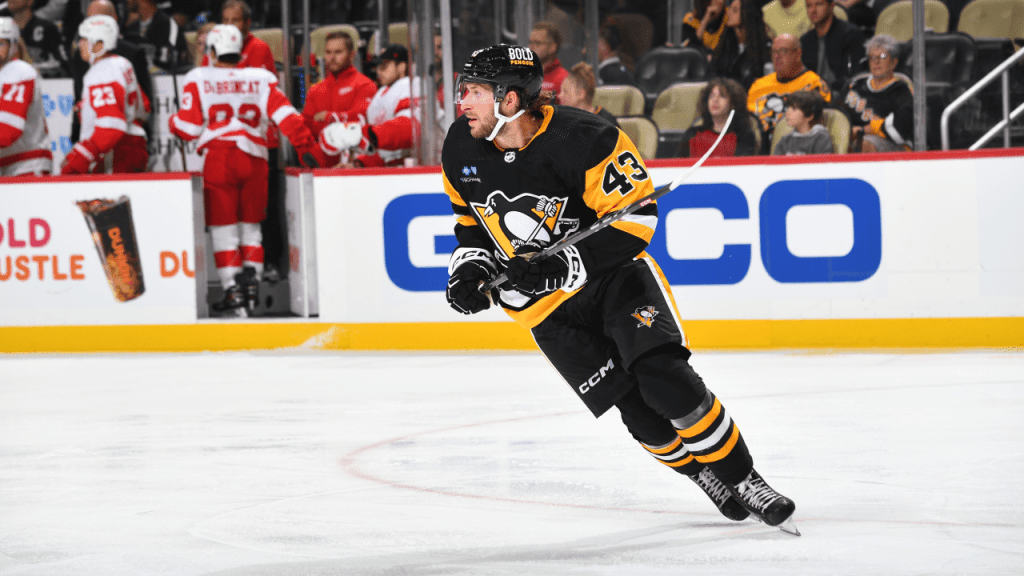
First, the Ducks signed Jansen Harkins, a 27 year-old winger, to a two year deal with an average annual value (AAV) of $787.5K. Harkins played in the Pittsburgh organization last season. His numbers in the AHL were good (12 points in 14 games), but he struggled to produce with the Penguins in the NHL, amassing 0 goals and 4 assists in 45 games. Harkins will likely shuffle between the Ducks’ 4th line, the bench, and probably even the AHL.
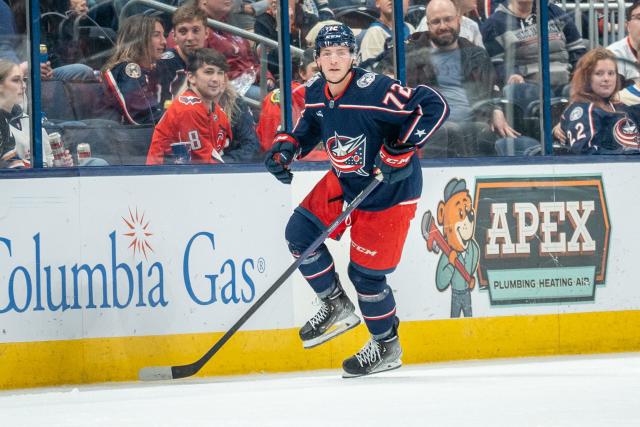
Next, Anaheim signed Carson Meyer, a 26 year-old winger, to a one year contract with an AAV of $775K (league minimum). Meyer has spent his entire career in the Columbus Blue Jackets organization. Last season, Meyer spent most of the season in the AHL, where he had 22 goals and 15 assists in 55 games. In 14 games in the NHL, Meyer had 1 goal and 1 assist. He will most likely be playing with the Gulls in the AHL next season.
Alright, now let’s get to the two bigger acquisitions the Ducks made via trades.
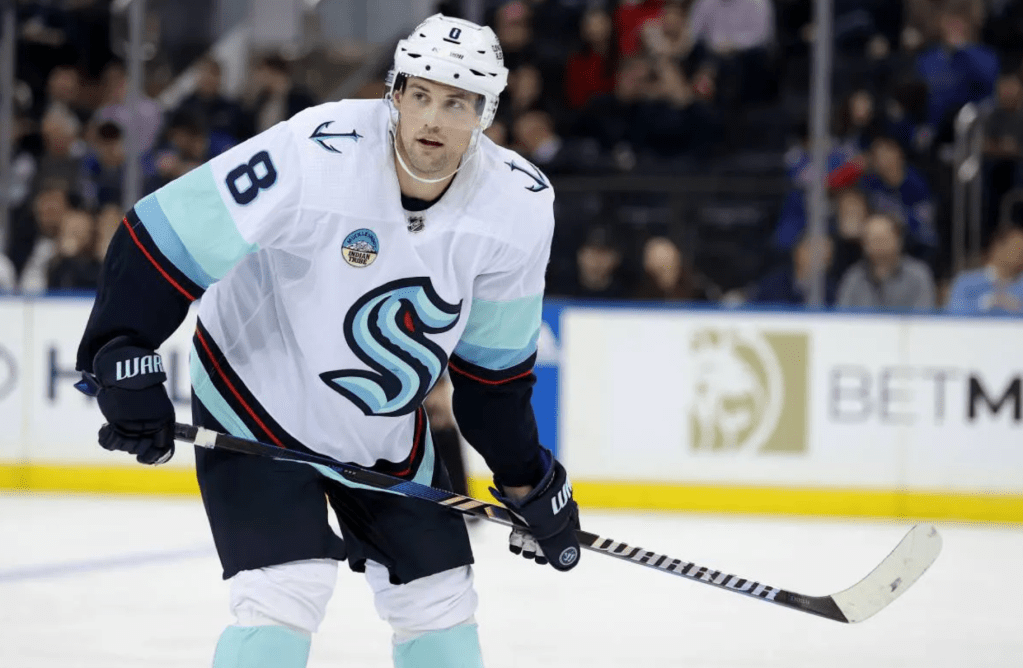
LHD Brian Dumoulin – 32 years old, 6’4″ 207 lbs
2023-2024 Regular Season Stats: 80 GP, 6 G, 10 A, 17:01 ATOI
Contract: 1 year, $3.15M AAV, 10 team no-trade list
Acquired: Traded to Anaheim from Seattle in exchange for a 2026 4th Round Pick
Player Overview:
Brian Dumoulin is a big defensive defenseman. Dumoulin is 6’3″, but he isn’t known to be a big hitter or shot blocker. Instead, he uses his size to block lanes and take space away from opposing forwards. Dumoulin does not have much offensive ability, but he can play reliable defensive minutes at even strength and on the penalty kill. Dumoulin is not in his prime anymore, but he is still a solid player who can fit in most lineups.
Player Analysis:
Dumoulin was a 2nd round pick of the Carolina Hurricanes in 2009. However, he was traded to Pittsburgh before leaving Boston College. With the Penguins, Dumoulin found a home next to Kris Letang, a prominent offensive defenseman at the time. Dumoulin’s steady presence allowed Letang to play an aggressive style in the offensive zone. Dumoulin was easily one of Pittsburgh’s most important defensemen on their championship teams in 2016 and 2017. Dumoulin’s play started to fall off a bit in his last couple of seasons in Pittsburgh, and he was let go as a free agent in 2023. He then signed with the Seattle Kraken, where he spent the 2023-24 season, and his play rebounded in a lesser role.
Dumoulin spent the majority of his season partnered with Justin Schultz on Seattle’s third defense pairing. After Schultz, his most common partners were Adam Larsson and rookie Ryker Evans. Dumoulin’s underlying numbers were very good with all of these partners. Among Seattle’s regular defensemen, Dumoulin ranked at or near the top in most possession statistics. At 5 on 5, Dumoulin had a 54.5% expected goal share, easily the best on the team (for more on expected goals, read this). He also gave up 2.04 expected goals per 60 minutes, which was only worse than Evans, who mainly played with Dumoulin. Even though Dumoulin faced easier matchups than the other pairings on Seattle’s roster, it is a good sign that his analytics held up regardless of who he played with.
While Seattle’s penalty kill wasn’t the greatest, Dumoulin was still one of the better players on the team at suppressing chances with a man down. Jamie Oleksiak and Adam Larsson took most of the penalty killing minutes, but Dumoulin held his own on the second penalty kill unit with Will Borgen. Dumoulin’s 7.31 expected goals against per 60 minutes on the penalty kill was right next to Borgen for the best on the team. As the second unit, they were more likely to go against weaker power play units, but they still did well in their minutes. The main takeaway for Dumoulin is that he might not be able to go against top competition anymore, but if you have the depth to shelter him, then he can excel at suppressing offense against in limited minutes.
The Fit:
Finding Dumoulin’s fit on Anaheim’s blueline will be interesting to follow. Currently, the Ducks have Cam Fowler, Pavel Mintyukov, Olen Zellweger, Urho Vaakanainen, Jackson LaCombe, and now Brian Dumoulin as left-handed defensemen. Radko Gudas is currently the only right-handed defenseman guaranteed to be on the team (Tristan Luneau could potentially be on the NHL roster, too). Ducks’ General Manager Pat Verbeek has been on record saying he prefers players play on their strong sides (left-handed players playing on the left side and right-handed players playing on the right side). This isn’t always possible, especially given the fact that there are more left-handed player than there are right-handed players, but it is something to keep an eye on. Last season, LaCombe and Zellweger played quite a bit on their weak sides, and I thought Zellweger was better at it than LaCombe was. I personally think LaCombe is in a precarious position with the current makeup of defensemen on the team. He is likely behind Fowler, Mintyukov, and Zellweger on the depth chart, and with the Ducks choosing to re-sign Vaakanainen and to acquire Dumoulin, LaCombe may be the odd man out in an effort to re-balance the handedness on the blueline. I can absolutely see him being used as a trade chip this offseason.
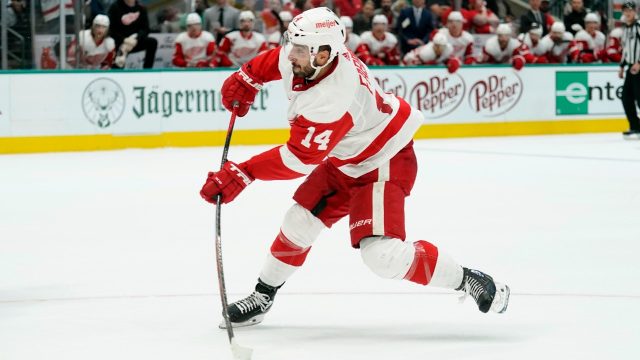
LW Robby Fabbri – 28 years old, 5’10” 190 lbs
2023-2024 Regular Season Stats: 68 GP, 18 G, 14 A, 12:52 ATOI
Contract: 1 year, $4M AAV
Acquired: Traded to Anaheim from Detroit with a 2025 4th Round Pick in exchange for G Gage Alexander
Player Overview:
Robby Fabbri is a smaller, offensive winger. He is not very fast for a forward, but he does possess a strong shot that allows him to score goals at even strength and on the power play. Fabbri is not known to be great defensively, and he does not kill penalties. He is known to be a hard worker, but injuries have slowed him down over his NHL career.
Player Analysis:
Fabbri was drafted by the St. Louis Blues in the first round in 2014. He was once a highly touted prospect, but a couple of major injuries halted his progress. To his credit, he has battled back from each of his injuries, but it has taken a toll on his career trajectory. St. Louis traded Fabbri to the Detroit Red Wings in 2019, and he has struggled to play a full season since then. Fabbri did play in 68 games this past season, the most he’s played in a year since his rookie season in 2015-16. He fell down the depth chart in Detroit and they decided to dump his salary to the Ducks this offseason.
Fabbri’s 18 goals in 68 games were impressive, especially for the relatively little amount of playing time he got, but his underlying numbers do not look nearly as good. The Red Wings were not a good team in both shot share and expected goal share, but Fabbri still ranked near the bottom in those categories. While Fabbri was on the ice, the Red Wings were actually able to generate decent offense. However, Fabbri’s on-ice defensive impacts were very poor. Detroit gave up 3 expected goals per 60 minutes with Fabbri on the ice, and that would have even ranked as the worst number on the Ducks. His numbers were pretty poor with nearly all of his teammates, which is a sign that he was part of the problem.
While Fabbri’s impacts at even strength are worrisome, his power play numbers look more promising. He had 5 goals and 7 assists on the power play last season. With Fabbri on the ice, Detroit generated 8.5 expected goals for per 60 minutes, only behind Patrick Kane on the team. Detroit did have a top 10 power play in the league last season, so we will have to wait and see if Fabbri’s success was a product of their system.
The Fit:
Fabbri is a bit of an awkward fit with existing Ducks’ roster. While his finishing ability should be a welcomed addition to the team, the rest of his game leaves a lot to be desired. He is not a particularly good defensive player, and Ducks’ forwards are already pretty weak defensively. He is also another left-handed forward who typically plays on the left side, which is the stronger side of the Ducks’ forward group. Troy Terry, Ryan Strome, and Brett Leason are currently the only right-handed forwards the Ducks have in the NHL (Sam Colangelo could potentially make the opening night roster). Fabbri will likely be on the third or fourth line, but he can probably move up the lineup if there are injuries. He can also probably spend some time on one of the power play units. Considering Detroit essentially paid the Ducks to take his money off their books, I do not mind the gamble on the player, I just have a hard time seeing him fit on this team.
Closing Thoughts:
Anaheim’s offseason got off to a disappointing start, especially when you consider that Pat Verbeek said his goal was to add a right-shot top 6 forward and a right-shot top 4 defenseman. He did not accomplish either of those tasks, even though it sounds like he tried. Sometimes, that’s just the way free agency goes, especially for a smaller market like Anaheim who has historically had challenges attracting free agents.
So far, we have seen the Ducks add Jansen Harkins, Carson Meyer, Brian Dumoulin, and Robby Fabbri. None of those names will move the needle much for the Ducks next season. I do think Dumoulin and Fabbri are small upgrades to the roster, but not to the point where the team outlook is much different.
While the busy part of the offseason is over, I would be very surprised if the Ducks don’t make at least one move before the season starts. I don’t think Verbeek is satisfied with the current state of the roster, and he has plenty of time to make changes. His available options might have been significantly reduced since July 1, but there is always something out there that can make your team better.

 All Mighty Hockey Talk
Leave a reply to marilynbarmash Cancel reply