
It’s taken longer than it has in previous years, but the Ducks have finally reached the point in the season where they are just playing for draft position and planning for the upcoming offseason. With 12 games to go, Anaheim is 13 points behind St. Louis for the final playoff spot, meaning they are essentially out of the picture. There were a few meaningful games recently, but the team did not play well when it mattered.
It’s been a disappointing albeit unsurprising stretch for a young team that has not experienced these high-leverage games before. Last season, the Ducks finished with an abysmal 59 points in 82 games. They are well ahead of that pace this season with 68 points in 70 games, but it’s tough to say how much progress they have really made.
The team has undoubtedly been propped up by its fantastic goaltending. Both Lukas Dostal and John Gibson have had excellent seasons, and they give the Ducks a chance to win every night. The Ducks have also started scoring more recently, and their goals per game has increased modestly from 2.48 last season to 2.64 this season. Part of this improvement can be attributed to much greater fortune in health. Last season, Anaheim’s offense was impeded by a myriad injuries to key players, making it hard to ice a competitive lineup that could build any continuity.
I do think the improvement in the standings does make a difference for the team, even if it is inflated by the team’s goalies. First, it gives the current players on the roster some hope that things are going in the right direction. Continuous losing becomes toxic because players feel like whatever they are doing isn’t working. Anaheim’s record is far from spectacular, but I have little doubt that the players feel better about the state of the team than they did last year.
Second, it also makes the organization a more attractive spot for free agents. On top of being a bad team for a number of years, Anaheim is also a small market team in a high-tax state. Needless to say, it has not been at the top of the list for free agents in recent seasons (or ever). A modest bump in the standings won’t suddenly make them a premier destination, but it is a signal that the team is trending upward. Coupling that with the amount of young talent on the team and in the pipeline, some free agents could look at investing in Ducks’ stock before it (hopefully) takes off. It also doesn’t hurt that Anaheim has plenty of money to spend in the offseason to try and supplement its young core.
The younger players have had mixed results in terms of their development this season. Jackson LaCombe is the obvious bright spot. He has emerged, almost out of nowhere, as the team’s best defenseman. His 37 points are more than double any other defenseman on the team, and he’s playing against top competition on a nightly basis. Cutter Gauthier has also improved quite a bit throughout his rookie season. He has 34 points in 70 games, and he looks much more comfortable than he did at the start of the year. Drew Helleson is not a player I have been super high on, but he has filled his role on defense admirably this season. I’m still not sure I see a long-term NHL fixture there, but he is a serviceable defenseman that can eat some minutes.
The rest of the young players have shows some flashes, but nothing that seems like a definitive step quite yet. All of Mason McTavish, Trevor Zegras, and Leo Carlsson have been putting up more points recently, but they still don’t bring the consistent impact they are capable of. Pavel Mintyukov and Olen Zellweger each spent time as healthy scratches this season, but neither of them have taken a firm grip on a regular spot in the lineup.
If the Ducks want to take another step toward the playoffs, there have to be some changes in the organization and positive steps in the development of young players. I have identified a few key areas that the team needs to address over the summer:
New Head Coach
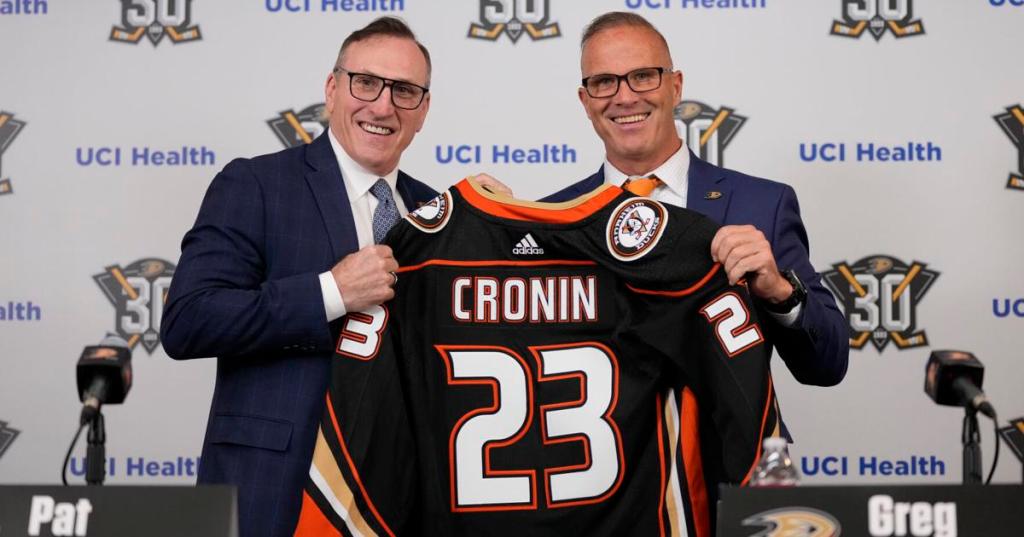
Hiring a new head coach has to be the team’s number one priority in the offseason. I am not someone who puts the blame on the head coach for everything, but it’s hard to ignore the lack of progress the team has made with Greg Cronin at the helm over the last two seasons.
If it wasn’t for elite goaltending, there is a legitimate chance that Cronin would have been let go already, even though the Ducks don’t fire coaches mid-season often. The Ducks are 28th (out of 32) in goals per game and 21st in goals against per game, even with a top 5 goalie duo this season.
We can look at expected goal numbers to get a better idea of how the team controls play at even strength, ignoring the play of the goalies (What is an Expected Goal?). According to both Natural Stat Trick and Money Puck, the Ducks are 3rd worst in the league in expected goal percentage (xG%) at 5-on-5, controlling only about 44% of expected goals. The only 2 teams lower than Anaheim are San Jose and Chicago, who are easily the 2 worst teams in the league.
Whatever Cronin wants his players to do on the ice is not working. Either he is not a good NHL head coach or this team is not built to play Cronin hockey, whatever that is. He has had 2 seasons to make this team better, but the results are not in his favor.
Another point to consider is the public perception of Cronin and its effect on the morale of the players and the attractiveness of the team. There has been gossip since the start of the season that players are not a fan of him. Former Ducks Ilya Lyubushkin and Jakob Silfverberg have made public statements that don’t paint Cronin in the best light. Big names in hockey media like Paul Bissonnette and Frank Seravalli have echoed these rumors, citing Cronin’s toughness on his players.
Whether that criticism is fair or even true, the fact of the matter is that it affects how other players view the Ducks. If I were a free agent with multiple offers, and one of them was from Anaheim, Cronin’s presence could definitely be a factor in my final decision. The Ducks are not a top destination for free agents, so they should be doing whatever they can to make themselves look more attractive. I believe the first (and most important) step to doing that is finding a new head coach.
How likely is it that Anaheim moves on from Cronin? The reality might depend on Cronin’s contract. It is unknown how many years he is signed for, but it could impact the team’s decision. I would be very surprised if his contract is longer than 3 years, so I have to believe that it is either for 2 or 3 years. If he only signed for 2 seasons, then I think there is about a 90% chance that he is gone after the season ends. If he is signed for 3 seasons, then I would say the chances drop to about 50-60%. The Ducks are not as trigger happy with firing coaches as some other teams are. It is also important to note that Cronin was GM Pat Verbeek’s first head coaching hire, and firing Cronin before his contract expires could be looked at as a blemish on Verbeek’s resume. Regardless of his contract term, I think there is still enough evidence to say that he is not the coach to get the Ducks to the next level, and the team should look for an upgrade this summer.
The Assistant Coaches Can Go, Too
While we’re at it, let’s just replace the entire coaching staff. Cronin deserves blame for the team’s performance, but I’m not letting the rest of group off the hook. It is hard to pinpoint everything that can be attributed to these coaches, but some of the results are hard to miss.
Rich Clune, a first year NHL assistant coach, is in charge of the forwards and the power play. All we really have to do is focus on the power play to assess how Clune is doing. Anaheim’s power play has been bad for a number of years, but somehow they are even worse this season, even though the team’s best players have been much healthier than in past years. They are operating at an outrageously bad 12.6% on the season, which is only better than the New York Islanders, who are at 12.4%. Nothing about it has worked, and it needs a serious revamp next year.
Brent Thompson, a veteran NHL assistant coach who is in his 2nd season with Anaheim, is in charge of the defense and penalty kill. Again, the play of the penalty kill alone is damning enough to consider a replacement. In Thompson’s first year with the Ducks, they had the 2nd worst penalty kill percentage in the league at 72.4%. This season, they are 4th worst in the league at 72.5%. It is simply not good enough.
Special teams are absolutely killing the Ducks this season. Anaheim’s goaltending has been so good at even strength that even having slightly below average special teams units would have them much higher in the standings. However, both units are in the basement of the league, and it has lost the team a lot of points this season. If it were up to me, I would be cleaning house and looking for an entirely new coaching staff for next year.
End the Gibson Saga
Last month before the trade deadline, I analyzed what the Ducks should do with John Gibson. He has had a great bounce back season after a few rough ones behind some terrible Ducks teams. Among goalies with at least 20 games played, Gibson ranks 5th in goals saved above expected per 60.
Gibson has been a huge positive for Anaheim this season, but he has been in trade rumors for years now. Playing on a terrible team has taken a toll on Gibson, and it shouldn’t be a surprise that he would prefer playing for a better team. I have maintained that I would only be interested in trading Gibson if either the Ducks get an offer they can’t refuse, or if Gibson legitimately wants to leave.
After the trade deadline, Sportsnet’s Eliotte Friedman reported that “there’s some frustration John Gibson didn’t get moved (from the player, the Ducks themselves and other clubs that have engaged) so that will kick up again in the off-season.” Gibson’s injury immediately before the deadline might have put a damper on a potential trade, but it seems like all parties want to move on. Mid-season goalie trades are difficult, so I always thought an offseason deal would be more likely anyway.
If a Gibson trade is going to happen, I have to think it would happen before July 1 (when free agency begins). Goaltending is such an important position that teams will want not want to risk waiting too long to secure it. A team will probably prefer signing a lesser free agent goalie on July 1 rather than banking for a Gibson trade to happen later in the offseason. Some teams that could be in the market for a starting goalie are Carolina, Columbus, Detroit, Edmonton, and Philadelphia. The stars are finally aligning and it really seems like this will be Gibson’s last season as a Duck.
Add a Scoring Forward
The Ducks have trouble generating scoring chances and, more importantly, capitalizing on scoring chances. They have young talent, but they have not figured out how to consistently beat goalies in the NHL. At the moment, no Duck has scored more than 20 goals this season. Frank Vatrano leads the team with 20, and he is followed by Troy Terry (19), Mason McTavish (18), Alex Kilorn (17), and Leo Carlsson (16).
Adding another forward to help with scoring goals with go a long way. Ideally, this forward would be a finisher, but a high-end playmaker would help, too. The issue, of course, is finding available upgrades. There are a few good unrestricted free agents out there: Mitch Marner, Nikolaj Ehlers, and Brock Boeser. There are some other lesser options, but those 3 are the best available. Acquiring a player through a trade is an option, but it’s difficult to pinpoint exactly who might be available.
One of the biggest issues facing the Ducks’ forward group right now is having players play too high in the lineup. Because they don’t have many high-end producers, some players are forced to play more minutes and against tougher competition than they should be. Adding a good forward would push another forward further down the lineup to a spot where they might perform better. Verbeek struck out on some big names last offseason, and I’m sure he will be taking some more swings this summer to help improve the team.
Figure Out Faceoffs
The Ducks are simply one of the worst faceoff teams of all time. Having a below average team faceoff percentage is one thing, but winning only 44.4% of all draws is pathetic. Winning more faceoffs won’t fix the team, but it will help alleviate some of the pressure that the team is constantly under.
At even strength, winning faceoffs might not seem like a big deal, but it adds up. The Ducks win 44.6% of draws at even strength, putting them on the back foot regularly. It gets even worse in the offensive zone, where the Ducks somehow only win 40.8% of faceoffs. The next worst team is at 46.4%. I have to imagine that even if the Ducks bumped that number up to just 45%, it would lead to at least a few more goals. If you can’t gain possession in the offensive zone, your offense has to waste energy getting the puck back. In the defensive zone, the Ducks are 2nd to last at 45.7%. This is giving their opponents a head start at creating offense and catching the defense off guard.
Faceoffs become even more important on special teams, as I previously discussed in another post. On the power play, it allows you to get more zone time and spend less time trying to enter the zone. On the penalty kill, you can clear the puck and waste time for the team with the advantage. Anaheim is easily dead last in power play faceoff percentage at 43.8% (next worst is Chicago at 46.7%). The Ducks have a similar win rate on the penalty kill at 43.5%, but this is only 10th worst in the league.
This offseason, something needs to be done about faceoffs. The young centers on the team will improve over time, but Anaheim should bring in somebody who can reliably win faceoffs either on the power play or on the penalty kill, or both.
Improve the 4th Line
The Ducks have rotated players like Isac Lundestrom, Ross Johnston, Brett Leason, Jansen Harkins, and Brock McGinn on the 4th line this season. Any combination of these players is doomed to fail.
Lundestrom is a talented skater and reliable defensive player, but his lack of offensive ability and poor faceoff win rate don’t make him an ideal 4th line/penalty kill center. If he were to improve his faceoff percentage to around 52%, he would be a more valuable player down the lineup. Lundestrom is a restricted free agent at the end of the season.
As for Johnston, I’m still not sure why he keeps getting into the lineup. He is meant to be an enforcer, but he doesn’t go out of his way to hit or intimidate anyone. He is essentially a policeman who arrives after something has already happened to maintain the peace, but he’s not even really good at that either. As far as playing hockey goes, I’m not sure there is a worse player in the league. Johnston has 1 more year on his contract after this season.
Leason has moments of offensive flash, but he lacks intensity and urgency in his game. You can see he has talent, but he also leaves you wanting more on a regular basis. Leason is a restricted free agent at the end of the season.
Harkins was signed to play in the AHL, but injuries forced him to play most of the season in Anaheim. He is decent at winning faceoffs, but he is so lackluster at every other part of the game that I don’t think that one positive is enough to put him in the lineup. Harkins has 1 more year on his contract after this season.
McGinn is probably the player in this group most suited to play a 4th line/penalty kill role. Unfortunately, injuries have taken a toll on him during his time with the Ducks. When healthy, I like the energy and grit he brings, and he even has some offensive touch at times. He just can’t be trusted to stay in the lineup. McGinn is an unrestricted free agent after this season.
I would try to give the 4th line a complete makeover next season. Johnston and Harkins should be sent to the AHL, and McGinn should not be re-signed. As for Lundestrom and Leason, I would look for upgrades over them, preferably including a competent center who can win faceoffs. If I can find replacements, I would look to move them, maybe keeping one of them as cheap depth. Someone like Nikita Nesterenko or Nathan Gaucher could be given shots at full-time roles next season, too.
The 4th line needs to have some sort of purpose or identity, and not just a line that goes out there to absorb minutes where you hope the other team doesn’t score. It could be a 4th scoring line, or a reliable hard-working defensive line, or a wrecking ball line that runs around and hits everything that moves. Anything would be better than what it has been this season.

 All Mighty Hockey Talk
Leave a comment