
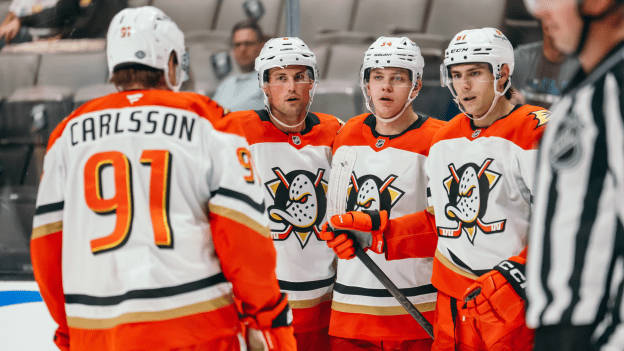
A brand new Anaheim Ducks’ season is finally here, and I’m choosing to celebrate by giving my thoughts on all 24 members of the Ducks’ season opening roster. Anaheim did not add much this offseason, but the team is looking for solid improvement, both in performance and health, throughout the squad.
I will be going through the roster by position, and we will be starting with:
Goaltenders
#1 – G Lukas Dostal
The 24-year-old goaltender is coming off a season where he established himself as a legitimate NHL option. In 44 appearances, Dostal put up a 3.33 goals against average and a .902 save percentage. While those numbers on their own aren’t all that impressive, it still represented a big step forward for the young netminder. In the offseason, Dostal backstopped Czechia to a gold medal at the annual IIHF World Championships. He earned that starting role, and his next goal is to do the same thing in Anaheim.
Heading into the 2024-25 season, Dostal is the current #1 goalie for Anaheim while John Gibson recovers from his appendectomy. With trade rumors swirling around Gibson, Dostal appears to be in line to grab the full-time starting job in the very near future. His performance while Gibson is out could solidify his place as a long-term fixture on the Ducks.
#36 – G John Gibson
Gibson, now 30 years of age, is finally starting to lose his grip on Anaheim’s starting job. Gibson only played in 46 games last season, his fewest in a non-shortened season since 2015-16. In those 46 games, Gibson recorded a 3.54 goals against average and a .888 save percentage. Those numbers are not good enough, and, to make matters worse for Gibson, they were worse than Dostal’s numbers in a similar amount of appearances. He finally has some serious competition for the starting role, and he’s on the verge of losing it.
Gibson will miss the first 1-4 weeks of the season while he rehabs from an emergency appendectomy. It could not have come at a much worse time, because this will give Dostal a prime opportunity to snatch the #1 spot and never look back. Gibson has also been involved in trade rumors for years. While I’m skeptical of him getting traded during the season given his cap hit and position, it seems likely that the Ducks will prioritize giving starts to Dostal. Gibson will have to make quite an impression when he gets his chances this season, because his time is running out.
#47 – G James Reimer
Reimer was claimed off of waivers from the Buffalo Sabres on October 7, just before the opening season roster lock. Reimer is coming off a decent season with the Detroit Red Wings, where he played in 25 games and recorded a 3.11 goals against average to go along with his .904 save percentage. At 36 years of age, Reimer is on the backside of his career, but he is still capable of being a reliable backup goalie.
The acquisition of Reimer protects the team while Gibson is out. The other internal backup options, Calle Clang and Oscar Dansk, are unproven and don’t provide Dostal with a reliable safety net. Reimer will be able to give Dostal some rest early in the season, but he will likely be put back on waivers when Gibson returns.
Defensemen
#2 – LHD Jackson LaCombe
The 23-year-old defenseman is coming off a tough rookie season. In 71 games, LaCombe put up 2 goals and 15 assists, but he often played on his weak side while getting difficult matchups next to Cam Fowler. He was clearly not put in a position to succeed, but he played much better in other spots in the lineup, specifically on his strong side next to Radko Gudas.
Throughout training camp, LaCombe has (surprisingly) been the most hyped player by the team. Gudas, Alex Killorn, and head coach Greg Cronin have all publicly commented on the growth they have seen in LaCombe since last season. It seems like he has found a home next to Gudas, and I expect to see that duo take on some tough minutes this season. LaCombe has also found himself on the Ducks’ top power play unit, which is a testament to what the coaching staff thinks of him. He beat out the likes of Fowler, Pavel Mintyukov, Olen Zellweger, and Tristan Luneau for that honor, but his security in that role will be determined by performance early in the season.
#4 – LHD Cam Fowler
Fowler is the longest tenured Duck, but his days may be numbered in Anaheim. The 32-year-old 1st round pick from 2010 is hoping to rebound after a rough year. Fowler played in 81 games last season, scoring 5 goals and 34 assists to lead the Ducks’ defensemen in points with 39. However, Fowler did also have a team worst -36 rating (LaCombe had the 2nd worst rating at -24), but it’s hard to put all the blame on Fowler for that number. He was often used against the opponent’s best players, and Fowler usually had to babysit one of the Ducks’ young defensemen (Luneau, LaCombe, Zellweger) at the same time. He was unfortunately set up to fail last season, but hopefully the team is better equipped to support him this year.
A few weeks ago, Sportsnet’s Elliotte Friedman reported that Fowler and the Ducks were working together on moving the defenseman to another team. This news came as a shock to Ducks fans, but it does make some sense. Anaheim has a number of young defensemen looking to claim a spot on the Ducks’ blue line in the near future, and Fowler does represent a road block for them. From Fowler’s perspective, he is entering the tail end of his career, and I would guess that he is tired of the losing that he has dealt with on this team in recent seasons. I’m sure he would welcome a move to a contending team. In the mean time, Fowler is playing next to 20-year-old Tristan Luneau to open the season, but for how long?
#5 – LHD Urho Vaakanainen
The 24-year-old defenseman is coming off his most successful season as a pro. Vaakanainen has always had difficulty staying healthy, but he played in a career high 68 games last season. He also scored his first (and only) career goal to go along with 13 assists. Vaakanainen played a lot next to Radko Gudas last season, but it may be difficult to get those minutes again this season.
Vaakanainen is currently slated to be the Ducks’ 7th or 8th defenseman, meaning he is likely to be a regular healthy scratch when the team is fully healthy. He does not have the upside that some of the younger defensemen do, so Vaakanainen’s playing time will not be considered a priority by the Ducks’ staff. However, he is a safe, reliable defenseman who can fill in whenever and wherever he is needed.
#6 – LHD Brian Dumoulin
Anaheim acquired Dumoulin from the Seattle Kraken this offseason in exchange for a 4th round draft pick. Last year, Dumoulin had a reduced role with Seattle, but he played it well. The 33-year-old defenseman had 6 goals and 10 assists in 80 games last season, but his value doesn’t come from producing offense. Dumoulin has always been a reliable defensive defenseman, and as a two-time Stanley Cup champion, he brings valuable experience that is critical to a young team like the Ducks.
Before acquiring Dumoulin, Fowler and Gudas were the only defensemen on the Ducks’ roster over the age of 24. Not only does Dumoulin’s presence take some pressure off of the rest of the group, but it also provides some insurance for the team if (when?) it trades Fowler. Dumoulin will most likely play next to one of the young studs the Ducks have on the blue line, and his responsible style of play will allow them to be more free offensively.
#7 – RHD Radko Gudas
It says a lot about Gudas that he was named captain of the Ducks after just 1 season with the team. He doesn’t seem like the loudest guy off the ice, but his energy and emotion come through in his play on the ice through his willingness to play physical and defend his teammates. The 34-year-old defensemen had 6 goals and 12 assists last season, and he also led the Ducks with a +14 rating. While +/- doesn’t tell the whole story, it is still very impressive to have that rating on such a poor team. The one area that Gudas needs to clean up is his propensity for taking minor penalties and putting the Ducks on the penalty kill.
With the C on his chest, look for Gudas to take on an even greater leadership role, especially now that he is more familiar with his teammates and coaches. He has mostly been playing with LaCombe in training camp, and it seems like that pair will get a lot of minutes. Gudas will also be a fixture on the team’s penalty kill (when he isn’t the one sitting in the box), which needs significant improvement from last season. Gudas played great last year, but the captaincy will put some extra responsibilities on his plate. It will be fascinating to see how he handles this new, elevated role as THE leader of the team.
#34 – LHD Pavel Mintyukov
The 20-year-old defenseman is entering his sophomore season in the NHL. Last year, Mintyukov surprised many by forcing his way onto the Ducks’ roster at 19-years-old. His season was cut short by injury, but in 63 games, Mintyukov recorded 4 goals and 24 assists. He played most of his minutes next to fellow Russian Ilya Lyubushkin, but now that Lyubushkin is gone, Mintyukov will have to find comfort next to another partner.
Mintyukov’s skills and smarts are undeniable, it’s now just about getting more experience and confidence. Currently, Mintyukov is playing next to Brian Dumoulin, who is playing on his weak side. I’m not sure how I feel about that pair at the moment, but putting Mintyukov on his strong side should help him feel more comfortable playing his game. I want to see Mintyukov play an assertive game, and putting him in positions to succeed is the best way to unleash that part of him.
#51 – LHD Olen Zellweger
Zellweger got a taste of the NHL last season after his call up from AHL San Diego. In 26 games, he recorded 2 goals and 7 assists. The 21-year-old mostly played on his off side with Cam Fowler in his short stint with the Ducks. In a recent post of mine about the impact of handedness on defensemen, I singled Zellweger out as the Ducks’ best candidate to play on his weak side. Ideally, he would play on his strong side, but with the current group of Ducks’ defensemen, that might be his best chance to crack the lineup.
Zellweger is currently slotted in as the #7 defenseman for the Ducks. With his upside, Zellweger should not be expected to be a regular healthy scratch. Of course, he will likely be the first replacement if there is an injury to another defenseman. Even if there is no injury, Zellweger will get playing time some other way. One option would be to simply send him back down to San Diego until a spot opens up. This would guarantee he gets prime playing time, even if it’s at a lower level. He can also rotate into the Ducks’ lineup for another defenseman every now and then to make sure he still gets some reps. Zellweger would also likely benefit from a Fowler trade, as that would open a spot in the lineup. Zellweger has a chance to be a big part of the Ducks’ blue line in the future, but in the mean time, he’s just going to have to work hard and be patient.
#67 – RHD Tristan Luneau
The 20-year-old defenseman is coming off a tumultuous season where he did not get to play much hockey. At the start of last season, Luneau played 7 games with Anaheim and 6 games with San Diego in the AHL. With the Ducks, Luneau scored his first career goal and added 2 assists. He was then released by the Ducks to play for Canada at the U-20 World Junior Championships in December. Unfortunately, Luneau came down with an illness, and then a knee infection, which wiped out the rest of his 2023-24 season. With that issue behind him, Luneau is poised to take a run at solidifying a spot on the Ducks’ blue line this season.
Currently, Luneau is playing next to Fowler. They played together last season, but they weren’t particularly successful in the tough matchups they were getting. Hopefully, the LaCombe-Gudas pairing can take some more challenging minutes away from them, freeing up Luneau to play his game. The fact that Luneau is a right-shot defenseman makes his development very important to the organization. After Luneau, the Ducks don’t really have a high-end right-shot defenseman prospect. Turning Luneau into a legitimate top 4 defenseman would go a long way in mapping out the Ducks’ future lineup.
Forwards
#11 – LW/RW/C Trevor Zegras
The ultra-talented 23-year-old is coming off a challenging season. Zegras only played 31 games due to injury, and he recorded a pedestrian 6 goals and 9 assists. Zegras’ offensive ability has never been in question, but he has been tasked with improving his all-around game. The trick for Zegras will be trying to maintain his offensive prowess while playing more responsibly to gain the trust of the coaching staff.
Based off of the preseason, it is clear the Ducks are still trying to find a comfortable spot for Zegras. He played all 3 forward positions, and he is currently playing right wing next to Mason McTavish and Robby Fabbri. With McTavish and Leo Carlsson entrenched in the top 2 center positions, Zegras would have to center the 3rd line to play has natural spot. The team seems to be leaning toward putting him on the wing to make sure he plays with more skilled linemates. In theory, I like pairing Zegras with McTavish, but they are admittedly a weak duo defensively. It is a worthwhile experiment to run, and it will be interesting to see where Zegras finally lands in the lineup.
#13 – LW Robby Fabbri
Anaheim acquired Fabbri early in the offseason from the Detroit Red Wings. Fabbri has had difficulty staying healthy throughout his career, but last year he played the most games he’s played in a single season since his rookie year in 2015-16. In 68 games, the now 28-year-old Fabbri notched 18 goals and 14 assists. With 1 year left on his contract, Fabbri is looking to boost his value to earn a more lucrative deal next offseason.
The good news for Fabbri’s wallet is that the Ducks will give him opportunities to play with talented players. He will likely see time on all 4 lines throughout the season, but for now he is playing next to Trevor Zegras and Mason McTavish on the Ducks’ 2nd line. On a new team, Fabbri has the chance to prove himself to a new coaching staff and new teammates. There is a decent chance the Ducks deal Fabbri at the trade deadline, but if he fits in well, he could stick with the club beyond this season.
#16 – RW/C Ryan Strome
The 31-year-old forward played in 79 games last season, amassing 11 goals and 30 assists. Strome put up passable scoring numbers, but the rest of his game left a lot to be desired. His defensive impacts have never been great, and he is prone to taking unnecessary minor penalties. If he doesn’t figure out how to minimize his negative impacts on the team, then he will continue to see a diminished role.
Strome is currently slated to center the 3rd line between Frank Vatrano and Troy Terry. Strome will be relied on for secondary scoring on this team, but he will mainly be looked to for his leadership and veteran presence. A successful season for Strome involves winning his minutes at the bottom of the Ducks’ lineup and staying out of the penalty box.
#17 – RW Alex Killorn
Killorn had an up and down first season with the Ducks last year. He broke his finger at the end of the preseason and missed the start of the regular season. After getting back into the lineup, he couldn’t find a groove, and then he opted to have arthroscopic knee surgery in January. It became clear that knee was bothering him because when he came back, he looked like a much more effective player. In the final 29 games, Killorn scored 12 goals and dished out 5 assists. Those aren’t spectacular numbers, but it was a clear improvement over the start of the season. The 35-year-old finished last season with 18 goals and 18 assists in 63 games. Now that Killorn has settled in with Anaheim, I expect him to build off of last season and look more like the player we saw in Tampa Bay for many years.
Killorn seems to have found a home next to budding superstar Leo Carlsson. Killorn’s playstyle gives Carlsson space to utilize his talents and make plays. Like a few others on the team, Killorn takes too many minor penalties. He isn’t the fastest player, so he often uses his stick and hands to impede opponents. Killorn’s line with Carlsson and other youngster Cutter Gauthier will be relied on to be the primary producers on this year’s squad. Killorn will also see time on both the power play and the penalty kill. A healthy Killorn will be an important complementary piece to a young Ducks’ lineup.
#19 – RW Troy Terry
Terry was 2nd on the Ducks last season in scoring with 20 goals and 34 assists in 76 games. It wasn’t his best season, but the now 27-year-old winger was still one of the Ducks’ most potent offensive players. One of Terry’s biggest issues has always been consistency. There are games where he is clearly the best player on the ice, and the puck is just glued to his stick. There are also games where he holds on to the puck for too long and turns the puck over before doing anything meaningful with it. Terry needs to find a balance where he can trust in his own abilities, but also trust in his teammates to do their jobs.
At the start of the preseason, Terry was on an intriguing line with Trevor Zegras and Mason McTavish. That line didn’t quite click in the short time they played together. All three of those talented players like having the puck on their sticks, so it makes sense that it could be a hard adjustment for them to share it so much. At the moment, Terry is playing next to Frank Vatrano and Ryan Strome. In the one preseason game we saw of this line, Terry looked to be very comfortable with those players. Strome and Vatrano will let Terry dance with the puck and do his thing while providing reliable support.
#20 – RW/C Brett Leason
The 25-year-old forward set career highs in goals, assists, and points last season. Leason had modest totals of 11 goals and 11 assists, but it represented a significant step in his professional career, solidifying himself as an NHL player. Leason was one of the only players who regularly played on the 3rd or 4th line that made a positive impact on the ice. With a deeper lineup this season, Leason’s role may shrink, but he is sure to be a fixture on the 4th line and on the penalty kill.
Before turning pro, Leason was mainly a center. However, he has mostly played right wing at the pro level. Late last season, the Ducks curiously put Leason at center again, and they continued to do so during training camp. At the moment, Leason is slotted in at right wing next to Isac Lundestrom and Brock McGinn, but don’t be surprised if you see Leason play more center as the year goes along. I would also guess that he and Lundestrom will split faceoff duties given the fact that Lundestrom has never been good on the dot. It will be interesting to see how Leason’s role evolves as the season goes on.
#21 – C Isac Lundestrom
After missing nearly half the season with an achilles injury, Lundestrom came back to score 5 goals and 6 assists in 46 games. The 24-year-old center has had trouble establishing himself as an impact player for the Ducks. His skating ability is undeniable, but the rest of his game is underdeveloped. Lundestrom is not a bad player by any means. He will rarely be the reason you lose a game, but he will also rarely be the reason you win a game. Lundestrom plays a very safe game, but he’s going to have to embrace a role to make himself a player worth keeping long-term.
Lundestrom is currently centering Brock McGinn and Brett Leason on the Ducks’ 4th line. In recent seasons, Lundestrom has been a fixture on the penalty kill. He will likely continue featuring on that unit, but his poor faceoff ability could lead to a reduced role as the Ducks put better players on the penalty kill. Lundestrom’s days in Anaheim could be numbered, and we could see him slowly phased out of the lineup as the year progresses if there is no tangible improvement in his game.
#23 – C Mason McTavish
McTavish showed glimpses of becoming a star last season, but injuries and inconsistency slowed down his hot start. In his first 20 games, McTavish had 10 goals and 11 assists. It took the rest of McTavish’s season to double that total. In his final 43 games, McTavish could only muster 9 goals and 12 assists. The 21-year-old center has the tools and makeup of a high-end forward, but he is still growing and developing his game. McTavish has had poor defensive results thus far in his career, and he takes a concerning amount of minor penalties. He has to clean up certain parts of his game before being considered a legitimate stud center in the NHL.
McTavish is currently locked into Anaheim’s 2nd line, and his linemates at the moment are Trevor Zegras and Robby Fabbri. This line absolutely has offensive updside, but I do worry about its ability to limit chances against. On the power play, McTavish is in the bumper spot on the top unit. I think this could be a great spot for him if he figures out ways to find open space and get shots off quickly (like Brayden Point in Tampa Bay or Sam Reinhart in Florida). McTavish is also the best faceoff man on the team, making him an important piece for the power play and 3-on-3 overtime. I also wonder if the Ducks consider using him on the penalty kill at all this season. McTavish will be a key contributor to Anaheim this season, and I hope to see him take the next step and smooth out the rough edges of his game.
#26 – LW Brock McGinn
A back injury limited the 30-year-old forward to 24 games last season. In a 4th line role, McGinn recorded 1 goal and 2 assists. It was certainly a disappointing year for the winger, but he looks to be healthy again heading into the 2024-25 season. McGinn has been a fixture on Anaheim’s penalty kill since he arrived at the 2023 trade deadline, and that will most likely be his main role on this roster.
McGinn has been playing with Isac Lundestrom and Brett Leason on Anaheim’s 4th line. McGinn does rotate with 13th forward Ross Johnston, so McGinn probably won’t be playing every game. He is in the final year of a 4-year deal, so McGinn will be fighting for his future NHL career this season.
#44 – LW Ross Johnston
In 68 games last season, Johnston put up 1 goal and 3 assists, but his game is not about producing points. The 30-year-old winger is on this team to play the role of enforcer. At 6’5″ and 232 lbs, Johnston has an intimidating frame, and he is a very experienced fighter. Even though he does fight a lot, Johnston rarely goes out of his way to start fights. It might be more accurate to call him a peacekeeper rather than an enforcer. Johnston tries to keep opponents in line when he is on the ice, and he will make them answer the bell for messing with his teammates.
Johnston will rotate in on the 4th line throughout the season. While he is considered one of the more feared fighters in the game, he doesn’t really inflict much punishment beyond the handful of fights he has each season. He’s not fast or mean enough to lay big hits with regularity, and he isn’t an annoying agitator that riles up opponents. I think he could use some more of that in his game, because his only real value as it stands is in his ability to make opponents answer for stepping out of line. In other words, he really only does something after an injustice has already occurred. This does have some value, but in today’s game, there isn’t a great need for someone like Johnston on a competitive roster.
#61 – LW Cutter Gauthier
Anaheim’s top rookie forward is coming off a very impressive sophomore season at Boston College. In 41 games, Gauthier scored a whopping 38 goals to lead all NCAA players, and he added 27 assists to give him a 65 point season, good enough for 2nd in the NCAA. At the end of last season, he played in the final game of the year for the Ducks and picked up a primary assist on a Jackson LaCombe goal. The 20-year-old forward is big and strong, especially for his age, and that combined with his elite shooting ability make him one of the top prospects in the world.
Gauthier played center in college, but he will be utilized as a winger, at least for the time being, on the Ducks. He is in a prime position next to Leo Carlsson and Alex Killorn on the Ducks’ top line. His role on that line is simple: get open and shoot the puck. And, if the preseason were any indication, he’s going to be very successful at that job. In his first preseason game, he put up a ridiculous 12 shots on goal (for context, Frank Vatrano led the Ducks last season with an average of 3.3 shots per game). Gauthier then scored a goal in each of the next two preseason games, both assisted by Leo Carlsson. Gauthier will also be a key component of Anaheim’s power play, and possibly even the penalty kill. Even though he’s just a rookie with 1 career NHL game under his belt, Gauthier is poised to make a huge impact on this team, and he very well could be a candidate for the Calder Trophy as the top rookie in the league.
#77 – LW/RW Frank Vatrano
Vatrano is coming off a career season where he lead the Ducks in goals and points. In 82 games, he put up an impressive 37 goals to go along with 23 assists to reach the 60 point plateau. All of those offensive stats were career highs for the now 30-year-old winger. Vatrano did a lot of his damage on the power play, where he led the Ducks with 13 goals and 20 points. He even led the Ducks with 3 shorthanded goals. Vatrano isn’t the best defensive player and he takes his fair share of minor penalties, but his elite shot makes him a unique and valuable asset to the team.
With a better lineup this season, the Ducks should be able to shelter Vatrano’s minutes more than last season, allowing him to face easier competition and not get exposed as much defensively. Vatrano is currently playing left wing next to Ryan Strome and Troy Terry on the 3rd line. That trio should be able to take advantage of weaker matchups and win their minutes. Vatrano will once again be a key weapon on one of Anaheim’s power play units, and he will likely continue to feature on the penalty kill, too. This is the last year of Vatrano’s 3-year contract, so he will certainly be motivated to improve on his performance from last season and earn an even bigger deal next summer.
#91 – C Leo Carlsson
Last but not least, we have the Ducks’ 19-year-old #1 center. Carlsson burst onto the scene last season and looked every bit the part of a franchise player in the making. He did face some injury issues in his first NHL season, but it’s not that surprising given his inexperience and lack of physical maturity. Carlsson was also on a unique load management schedule that saw him sit some games out in favor of getting extra off-ice workouts. In 55 games, Carlsson had 12 goals and 17 assists. Those numbers might not jump off the page, but you could easily see the potential Carlsson has to be a dominant player in the NHL one day.
With a year of NHL experience and a full offseason of training under his belt, Carlsson should be better equipped to handle the rigors of an NHL season. He will be the top center on the team, and he is currently situated between Cutter Gauthier and Alex Killorn. The trio looked impressive in the preseason, and their chemistry should only improve with time. Carlsson will be the main facilitator on Anaheim’s top power play unit, and he will also be given some time on the penalty kill this season. His brain, build, and skillset make him an excellent candidate to improve a penalty kill group that was pitiful last year. Carlsson’s rookie season was his introduction to the NHL, and this year we should see him start to blossom into the elite, all-situations center that he is destined to become.
Current Lineup
Forwards
Line 1: Gauthier – Carlsson – Killorn
Line 2: Fabbri – McTavish – Zegras
Line 3: Vatrano – Strome – Terry
Line 4: McGinn – Lundestrom – Leason
Scratch: Johnston
Defensemen
Line 1: LaCombe – Gudas
Line 2: Fowler – Luneau
Line 3: Mintyukov – Dumoulin
Scratch: Vaakanainen, Zellweger
Goalies
Starter: Dostal
Backup: Reimer
Injured: Gibson
 All Mighty Hockey Talk
Leave a comment